
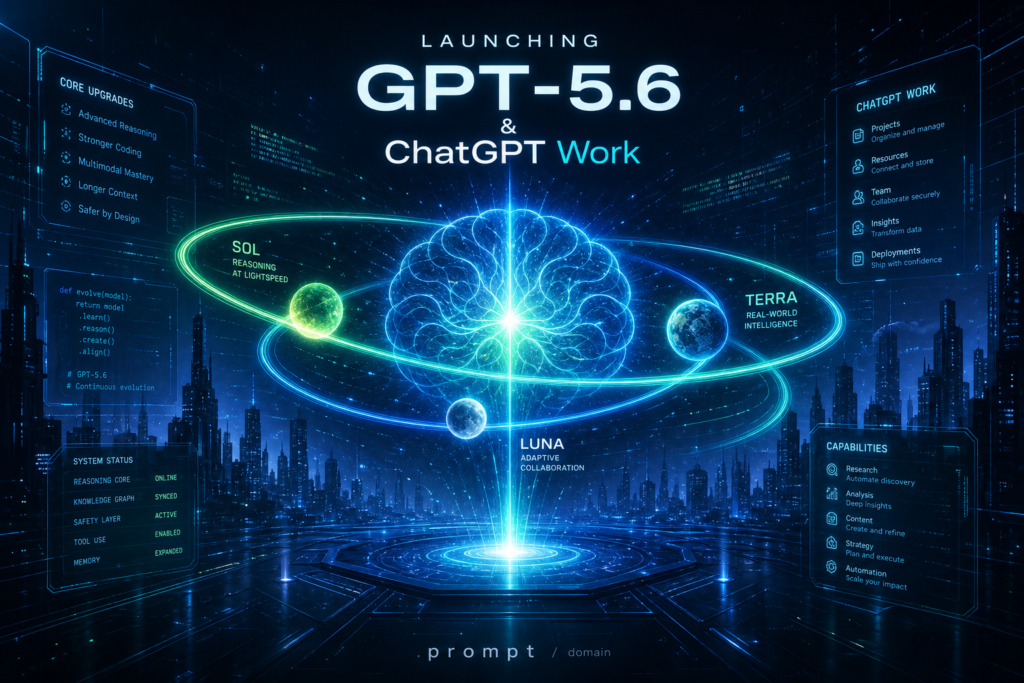
On July 9, 2026, OpenAI released GPT-5.6 and ChatGPT Work, a launch that signals a fundamental shift in how AI interacts with work. The three-tiered GPT-5.6 model suite (Sol, Terra, Luna) and the new ChatGPT Work agent are designed to automate complex workflows, marking the transition from AI as a chatbot to AI as a proactive coworker.
The GPT-5.6 lineup offers a tiered approach to performance and cost. Sol is the most powerful model, designed for complex reasoning and multi-step tasks. Terra is the balanced, general-purpose option, while Luna is optimized for speed and efficiency. Pricing reflects this hierarchy: Sol costs $5 per million input tokens and $30 per million output tokens, Terra is $2.50/$15, and Luna is $1/$6.
Sol’s most significant new feature is Ultra mode, which uses a system of subagents to delegate and parallelize complex work. According to OpenAI, Sol is 54% more token-efficient on agentic tasks than Anthropic’s latest models, a key metric as companies race to build more capable AI agents at scale.
ChatGPT Work is the consumer-facing application of this capability. It integrates directly with Codex, which is merging into the ChatGPT desktop app, and introduces "Scheduled Tasks." This feature allows the agent to work independently on pre-defined objectives, such as monitoring data, preparing reports, or drafting communications, without continuous prompting.
The launch positions OpenAI in direct competition with Anthropic’s Claude Cowork and Microsoft’s Copilot suite, both of which are pushing similar agent-based workflows. The emphasis on token efficiency, especially in Sol, suggests that the cost and performance of agentic AI will be the next major battleground for enterprise adoption.
Sam Altman noted that a staggered rollout was requested by government officials, a detail that hints at the increasing regulatory scrutiny surrounding advanced AI capabilities. GPT-5.6 Sol will also be made available through Cerebras at 750 tokens per second, emphasizing the ongoing push for inference speed.
The core implication of this launch is that AI agents are becoming the new "domain" of work. Just as domain names like .com or .io became the foundational identity layer of the early internet, AI agents are now becoming the primary interface for navigating and completing digital work. An agent’s ability to act across files, applications, and services is redefining what a "workspace" is.
For developers and AI professionals, this shift creates a new requirement for digital identity. Your work is no longer just a website or a GitHub repository; it is the set of prompts, models, and agent interactions you build and manage. As this ecosystem matures, the need for a dedicated, recognizable identity that signals your focus on AI becomes more critical.
The .PROMPT domain was created for this new era. It provides a distinct and trusted digital home for the people and tools building the agent-driven future. Whether you are developing a specialized model, offering prompt engineering services, or building the infrastructure that powers these agents, a .PROMPT domain clearly communicates your role in the AI community. As the agent era begins, your digital identity should reflect where the work is actually happening. You can explore available namespaces at https://promptdomains.ai.

Leave a Reply