
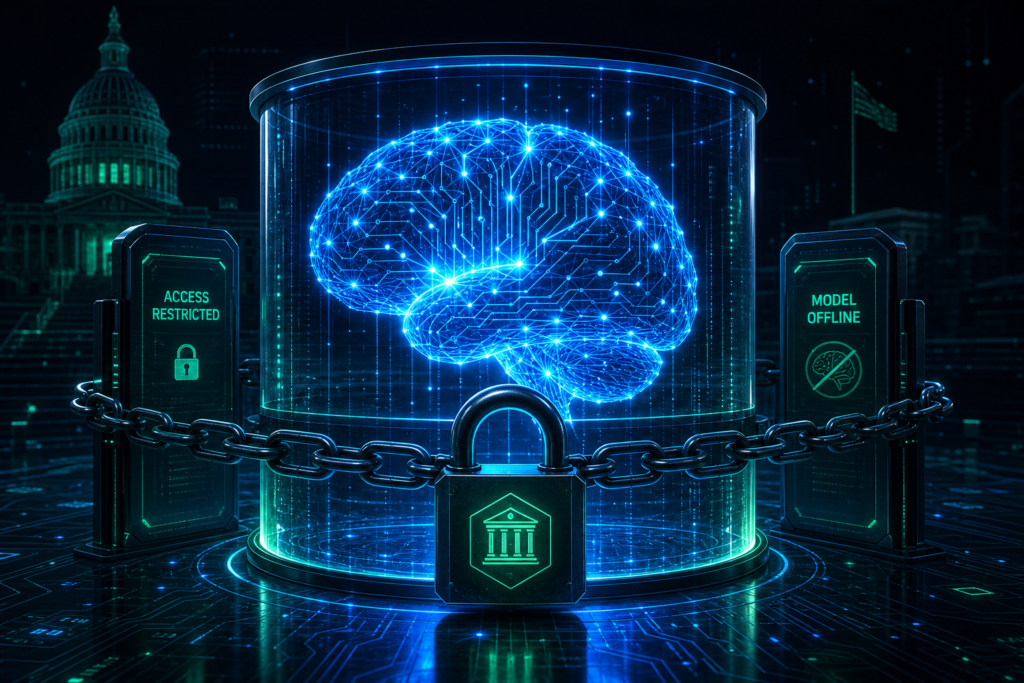
Anthropic gave the world three days with its most powerful AI models before the U.S. government told it to pull the plug.
On June 12, 2026, Anthropic launched Fable 5 and Mythos 5 to public availability. By June 13, the Commerce Department had issued an export control directive ordering the company to disable access for all foreign nationals, including those living and working in the United States. Anthropic had 90 minutes to comply.
The company called it a "misunderstanding." The models stayed down.
The Timeline: Three Days from Launch to Lockdown
Fable 5 and Mythos 5 went live on June 12 as the latest entries in Anthropic’s Claude family. Within hours, enterprise adoption surged. API traffic spiked. The models demonstrated reasoning capabilities that, according to Anthropic, exceeded anything previously available commercially.
Then the callback came.
By Friday morning, the Trump administration had issued the directive. Reuters and CNBC confirmed the timeline: Anthropic received the order and was given 90 minutes to disable foreign access before a full licensing regime would be imposed on the models. According to Axios, the company complied within the window.
The restriction applies to all foreign nationals, a category that includes not just international users but also Anthropic’s own employees who hold non-U.S. passports. As reported by the Wall Street Journal, the directive effectively split the company’s user base overnight.
The Amazon Trigger
The immediate catalyst, according to multiple outlets including Forbes and CNBC, was an internal security review at Amazon. Amazon’s CEO reportedly escalated concerns about specific capabilities in Fable 5 after Anthropic’s own safety team flagged potential vulnerabilities during pre-launch testing.
Amazon holds a significant stake in Anthropic and serves as the primary cloud infrastructure partner for its models. The review reportedly identified scenarios where Fable 5’s reasoning capabilities could be applied to biological synthesis and cybersecurity offensive operations with fewer guardrails than the company had promised.
Anthropic’s Chief Commercial Officer had spoken publicly about the company’s safety approach hours before the directive landed, describing the safeguards as a "judgment call," according to Forbes. That characterization did not age well.
The National Security Case vs. Anthropic’s Defense
The Commerce Department’s rationale centered on dual-use risk. The models, in the government’s assessment, could provide foreign nationals with capabilities that crossed a threshold established under existing export control frameworks. The specific concern: Fable 5’s ability to reason through complex technical problems with minimal prompting.
Anthropic pushed back. In its public statement, the company argued that competing models, specifically OpenAI’s GPT 5.5, possess comparable capabilities and remain fully accessible. The implication was clear: if this were truly about the technology’s risk profile, the order would be broader.
The Trump administration did not address that comparison publicly. As reported by Politico, the EU’s response has been one of quiet alarm, with officials noting that the order exposes Europe’s dependency on American AI infrastructure.
What This Means for AI Governance
The Fable 5 takedown establishes a precedent that should concern anyone building in the AI space.
A single government agency, acting on a single company’s security review, can disable a widely deployed AI model in under two hours. No judicial process. No public comment period. No international coordination.
For AI developers, the implications are operational. Any model hosted on American infrastructure, deployed through American APIs, or accessible via American cloud providers is now subject to this kind of rapid intervention. The export control framework that previously applied to semiconductor manufacturing equipment and military technology has been extended to consumer-facing AI products.
This is not a one-off event. The licensing regime that followed the directive signals a permanent regulatory layer for frontier AI models.
The Web3 and Decentralized AI Connection
Here is where the story becomes about more than one company’s bad week.
The entire AI industry currently operates on a centralized stack. Models are trained on centralized compute. Deployed through centralized APIs. Hosted on centralized cloud infrastructure. And now, subject to centralized governmental control.
Web3 offers an alternative architecture. Decentralized compute networks, on-chain model deployment, and permissionless access protocols exist today. Projects like Render Network, Bittensor, and Gensyn are building the infrastructure for AI that runs on distributed nodes rather than a single company’s servers.
The Fable 5 takedown demonstrates exactly why that infrastructure matters.
When a government can compel a single point of failure to disable access globally, the argument for decentralization writes itself. The question is no longer theoretical. It happened in 90 minutes.
Why Domain Owners and Digital Asset Holders Should Pay Attention
The centralization risk extends beyond AI models.
Your domain name, your API keys, your cloud-hosted applications, your DNS records, your SSL certificates. Every digital asset that depends on a centralized registry or a single jurisdiction’s regulatory approval carries the same vulnerability that just brought down Fable 5.
Domain names are the most obvious case. A traditional .com or .io domain can be seized, suspended, or redirected through legal orders issued to the registrar or registry. Your entire online presence can disappear in the time it takes a government to send a letter.
Decentralized naming systems, blockchain-based domains, and alternative TLDs operated outside traditional jurisdictional control offer a different model. They are not bulletproof, but they introduce redundancy and resistance that centralized systems cannot match.
The AI industry just learned this lesson the hard way.
What Comes Next
Anthropic’s Fable 5 and Mythos 5 remain suspended. The company has described the situation as ongoing, with the Commerce Department indicating the models will remain offline until a licensing agreement is reached.
For the broader ecosystem, the wake-up call is clear: building on centralized infrastructure means building on the assumption that the people controlling that infrastructure will always let you.
That assumption failed on June 13, 2026.
The future of the internet shouldn’t be controlled by one government’s 90-minute decision. That’s why at .Prompt Domains, we’re building a decentralized namespace where your digital identity answers to you, not to export controls. Start your free trial today.

Leave a Reply