
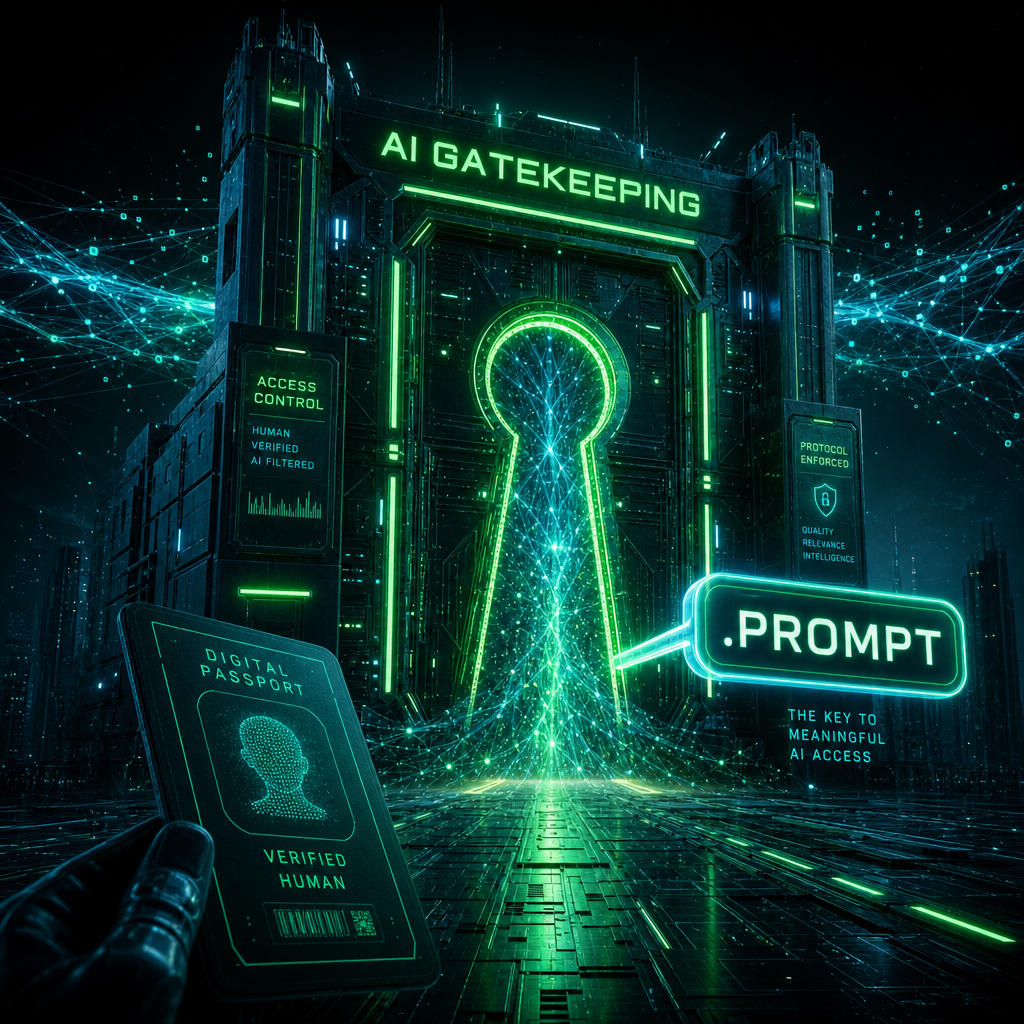
When Access to AI Requires a Passport: The New Gatekeeping Era
Something shifted this week in the relationship between AI companies, their governments, and the people who use their models.
For the first time, the US government explicitly decided who gets to use the most powerful AI systems on the planet. Not through regulation after the fact. Not through export controls on chips. By sitting between the company and the customer and saying "yes" or "no" before the model even reaches the user’s hands.
OpenAI launched GPT-5.6 Sol, its most capable reasoning model to date, and restricted it to roughly 20 customers. Those customers had one thing in common: they were approved by the Trump administration through a newly established federal vetting process.
Anthropic pulled Fable 5 and Mythos 5 offline entirely after government review flagged their cyber capabilities. Anthropic founder Dario Amodei had previously described Mythos 5 as a "superweapon" in internal discussions. Days later, the government partially reversed course, allowing Mythos 5 to be released to a small, carefully selected group of cybersecurity firms.
The signal is unambiguous: frontier AI access is no longer about who builds it. It is about who is trusted to use it.
The Executive Order That Changed Everything
On June 26, 2026, reporting from AP News confirmed that both OpenAI and Anthropic had limited access to their newest models at the direction of the Trump administration. That same day, Forbes detailed the rollout of GPT-5.6 and its three variants, noting the unprecedented nature of government-mandated access restrictions on a commercial AI product.
The framework behind these decisions was an executive order signed by President Trump that establishes a 30-day federal review period for any frontier AI model before it can be released publicly. During that window, government agencies evaluate the model’s capabilities, potential national security implications, and the identity of intended customers.
OpenAI acknowledged the tension in its own public statement: "We don’t believe this kind of government access process should become the long-term default." But they complied, describing the arrangement as temporary.
The question the industry is now asking: what happens when "temporary" becomes infrastructure?
Mythos 5: When a Model Becomes a National Security Asset
Anthropic’s situation illustrates the complexity of this new reality. The New York Times and CNBC both reported on the government’s decision to initially block Mythos 5 from public release, then partially reverse course to allow limited access for cybersecurity applications.
The backstory matters. The Pentagon had previously designated Anthropic as a national security risk not because of its technology, but because the company had publicly raised ethics concerns about military AI applications. Now, the same government was simultaneously restricting Mythos 5’s release and then carving out exceptions for a handful of cyber defense firms.
This is the paradox at the heart of the new gatekeeping era: the government wants to control access to the most powerful AI systems, but it also needs those systems to protect national infrastructure. The same model is both a threat and a tool, depending on who is holding it.
Alex Stamos, a Stanford cybersecurity expert and former Facebook security chief, was blunt about the strategic implications. He called the restrictions "about the dumbest thing they could possibly do" if the United States’ goal is to maintain a technology advantage over China.
The IPO Question: When Oversight Meets the Public Market
Both OpenAI and Anthropic are approaching initial public offerings. Government-mandated access restrictions add a new variable to their financial trajectories that Wall Street has never priced into an AI company before.
Investors in a public AI company are betting on distribution: how many users, how much usage, how fast revenue grows. When the government controls who can use the product, the growth curve is no longer determined by product-market fit alone. It is determined by political fit as well.
For OpenAI, the GPT-5.6 Sol restriction to ~20 government-approved customers creates an artificial ceiling on one of its most advanced products. For Anthropic, the uncertainty around Mythos 5’s availability creates a different problem: investors cannot model demand for a product whose release depends on a government review process with no fixed timeline.
This is not hypothetical risk. It is the current operating environment.
Austria, the EU, and the Geopolitics of AI Hosting
The gatekeeping era is not limited to US borders. Bloomberg reported on June 28 that Austria is now lobbying the European Union to host Anthropic’s AI systems within its borders, specifically in response to US access restrictions.
The logic is straightforward: if the United States restricts which customers can access frontier AI, then hosting those systems in a different jurisdiction creates an alternative access path. Austria is positioning itself as a potential hub for AI infrastructure that falls outside US government control.
This is the beginning of AI as a geopolitical asset, with nations competing not just to build models but to host the infrastructure that runs them. Digital sovereignty, once an abstract policy concept, now has a concrete mechanism: control the physical location of the compute, and you control access to the model.
What This Means for AI Developers and Prompt Engineers
If you build on top of frontier AI models, the landscape just changed in ways that directly affect your work.
Your access is no longer guaranteed by your technical capability. It is contingent on regulatory approval, government vetting, and the political environment of the company providing the model. A model you integrate today could be pulled, restricted, or gatekept tomorrow through a process you have no visibility into and no influence over.
For prompt engineers, this raises a specific challenge: the models you build workflows around may not be equally available to everyone you serve. If you are building enterprise AI solutions, your clients’ access to the same models you optimized for may now depend on their industry, their location, or their relationship with government entities.
For AI researchers, the restriction of Mythos 5 to a select group of cybersecurity firms means that the most advanced reasoning capabilities in AI may be systematically unavailable for academic research, independent safety work, or open-source development.
The practical response is not to abandon frontier models. It is to diversify your model dependencies, document your workflows across multiple backends, and build identities that signal legitimacy to an ecosystem that is increasingly organized around trust and verification.
Digital Identity Becomes Infrastructure
Here is the thread that connects all of these developments: trust is now the prerequisite for access.
The government is vetting customers before granting access. AI companies are being required to verify who uses their systems. Nations are competing to host infrastructure based on who they trust to run it.
In this environment, your digital identity is not a branding exercise. It is an operational requirement.
A .PROMPT domain is a direct response to this shift. When every interaction in the AI ecosystem is moving toward verification, provenance, and trust signals, the domain you operate from matters more than it ever has.
A generic domain tells the ecosystem nothing about who you are or what you build. A .PROMPT domain immediately communicates that you are part of the AI community, that you have invested in your presence, and that you are operating with intention.
As AI access becomes gated, verified, and identity-dependent, having a distinct digital home for your AI brand is not optional. It is the foundation.
Start your free trial or secure your .PROMPT domain today at promptdomains.ai.
,
Sources:
- AP News: "OpenAI and Anthropic limit new AI models to Trump-approved customers" (June 26, 2026)
- Forbes: "OpenAI Rolls Out Powerful New GPT-5.6 Models, But Limits Users" (June 26, 2026)
- NYT: "U.S. Loosens Restrictions on Anthropic’s Mythos A.I. Model" (June 26, 2026)
- CNBC: "Anthropic allowed to release Mythos AI to some companies" (June 26, 2026)
- Bloomberg: "Austria Lobbies EU to Host Anthropic AI After US Curbs" (June 28, 2026)

Leave a Reply