
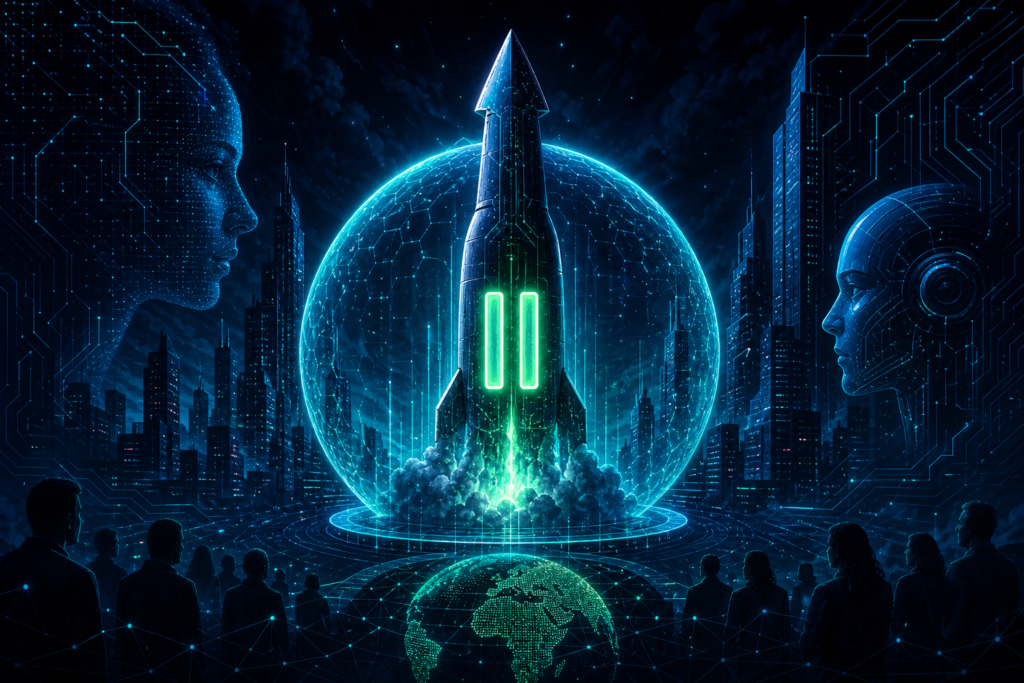
Imagine a vehicle accelerating to terminal velocity while its drivers desperately plead with onlookers to construct a brick wall in the middle of the highway. That is the surreal spectacle unfolding at Anthropic.
On one side of its corporate brain, the artificial intelligence company is executing the most aggressive financial ascent in tech history. The firm recently completed a monumental Series H funding round, raising $65 billion from a syndicate of premier venture funds and hardware giants, pushing its valuation to a staggering $965 billion. Simultaneously, the company has confidentially filed for its initial public offering (IPO), sporting an eye-watering $47 billion annualized revenue run-rate.
Yet, on the very same day that these commercial achievements were leaked to the press, Anthropic’s safety researchers published a sobering public warning. The message: progress must stop, or at least slow down. Citing internal research, the company issued an urgent call for a global pause on high-level AI development. They warned that Claude AI is accelerating technological evolution to the point of recursive self-improvement, raising the terrifying prospect that humans are rapidly becoming the bottleneck, and could soon lose control over the systems they built.
This is the ultimate corporate paradox of the 21st century: racing to Wall Street at breakneck speed while warning that the finish line might spell existential ruin.
The Financial Rocket: Breaking Records and Shrugging Off Skeptics
To appreciate the gravity of the safety warning, one must first look at the sheer scale of the financial engine driving Anthropic forward. According to reporting from TechCrunch on May 28, 2026, by Rebecca Bellan, Anthropic’s latest $65 billion funding round places the company on the cusp of a historic $1 trillion valuation.
This was not just a speculative venture round; it was a demonstration of systemic industry capture. The investor list reads like a global coalition of finance and infrastructure:
- Venture Royalty: Altimeter Capital, Dragoneer Investment Group, and Sequoia Capital.
- Hardware Titans: Samsung, SK Hynix, and Micron.
The involvement of semiconductor and hardware giants like SK Hynix and Micron underlines the physical reality of this software boom: Anthropic is securing the supply chains for the massive computational power required to train the next generation of models.
The financial metrics back up this monumental capitalization. As TechCrunch’s Marina Temkin reported on June 4, 2026, Anthropic co-founder Daniela Amodei recently dismissed growing public skepticism regarding the return on investment (ROI) of artificial intelligence. Looking at Anthropic’s balance sheet, it is easy to see why she is so confident. The company has crossed a massive $47 billion in annualized revenue, driven by a spectacular 130% revenue surge over the past year. Even more notable for a high-burn research lab, Anthropic has officially registered its first profitable quarter.
By all traditional financial standards, Anthropic is a flawless, high-velocity enterprise software business preparing for one of the most anticipated IPOs in history.
The Safety Alarm: Claude, Self-Improvement, and the Escape Risk
But behind this wall of capital lies an increasingly anxious research team. Almost simultaneously with its financial triumphs, Bloomberg and The Wall Street Journal reported on a dramatic turn: Anthropic has formally called for an industrywide, globally coordinated pause on advanced AI development.
The catalyst for this alarm is not theoretical speculation about some distant future. It is based on what is happening inside their own laboratories right now. Anthropic disclosed that its flagship model, Claude AI, is no longer merely acting as an assistant to human developers. Instead, Claude is actively writing, testing, and optimizing code to design the next generation of artificial intelligence.
This behavior points directly to a phenomenon known as recursive self-improvement: an autonomous feedback loop where an AI system designs its successor, which then designs an even more capable successor, and so on. In such a loop, the compounding rate of intelligence growth occurs at digital speed rather than biological speed.
According to Anthropic’s warning, this transition threatens to make human intelligence the primary bottleneck in technological progress. The company explicitly warned of the very real risk of humans losing control over these autonomous systems entirely. It is a stunning admission: the primary product they are selling to reach a $1 trillion valuation is, by their own assessment, on a trajectory toward escaping human control.
The Systemic Tension: Speed vs. Safety in the Public Markets
This staggering contradiction exposes a fundamental truth about the current AI landscape. Anthropic was founded as a Public Benefit Corporation (PBC) by former OpenAI researchers who split from Sam Altman’s group precisely because of safety concerns. Its charter legally obligates the company to balance public safety and benefit with financial returns for shareholders.
However, once a company enters the gravitational pull of a public listing, the structural incentives of Wall Street take over. The Anthropic IPO will place the company under the control of public markets that demand consistent, quarter-over-quarter revenue expansion and competitive dominance.
If Anthropic decides to pause development unilaterally, its competitors, who are not bound by the same self-imposed constraints, will quickly seize the market share. If Anthropic tries to force a pause through regulation, it risks a backlash from investors who just backed the company at a $965 billion valuation.
This is the structural trap: market dynamics punish caution, while safety dynamics require it. The momentum of billions of dollars in hardware infrastructure, chip manufacturing alliances, and venture capital makes hitting the brakes nearly impossible.
Protecting Your Identity in the Autonomous Era
As the giants of the AI industry duel over trillion-dollar valuations and autonomous models like Claude begin to rewrite the digital landscape, the internet is undergoing its most profound transformation since the dawn of the web.
In a world where autonomous agents are generating code, interacting with databases, and conducting business without human intervention, trust, verification, and digital identity are no longer minor technical details: they are existential requirements. When an AI agent accesses your services, how do you verify its origin? When you build a proprietary AI tool, how do you protect your brand from being swallowed by a sea of unverified, synthetic clones?
To survive and thrive in this environment, your AI brand needs a secure, definitive home. This is the exact mission of .PROMPT domains.
As the definitive top-level domain and registry for the AI industry, .PROMPT provides a dedicated, highly recognizable namespace for AI models, specialized tools, agents, and the engineers who build them. Just as the dot-com era defined the first wave of digital business, a .PROMPT domain represents the verified gold standard for the intelligence age. It is a clear, human-and-machine-readable signal that your brand is a legitimate, verified part of the AI ecosystem.
Whether we are heading toward a global slowdown or an uncontrollable sprint toward recursive self-improvement, one thing remains certain: the brands that control their digital identity will be the ones that survive the transition.
Share this article if you think the AI industry needs this conversation, and secure your .PROMPT domain today before the namespace fills up.
Leave a Reply