
Chat is dead. Not dying. Not declining. Dead.
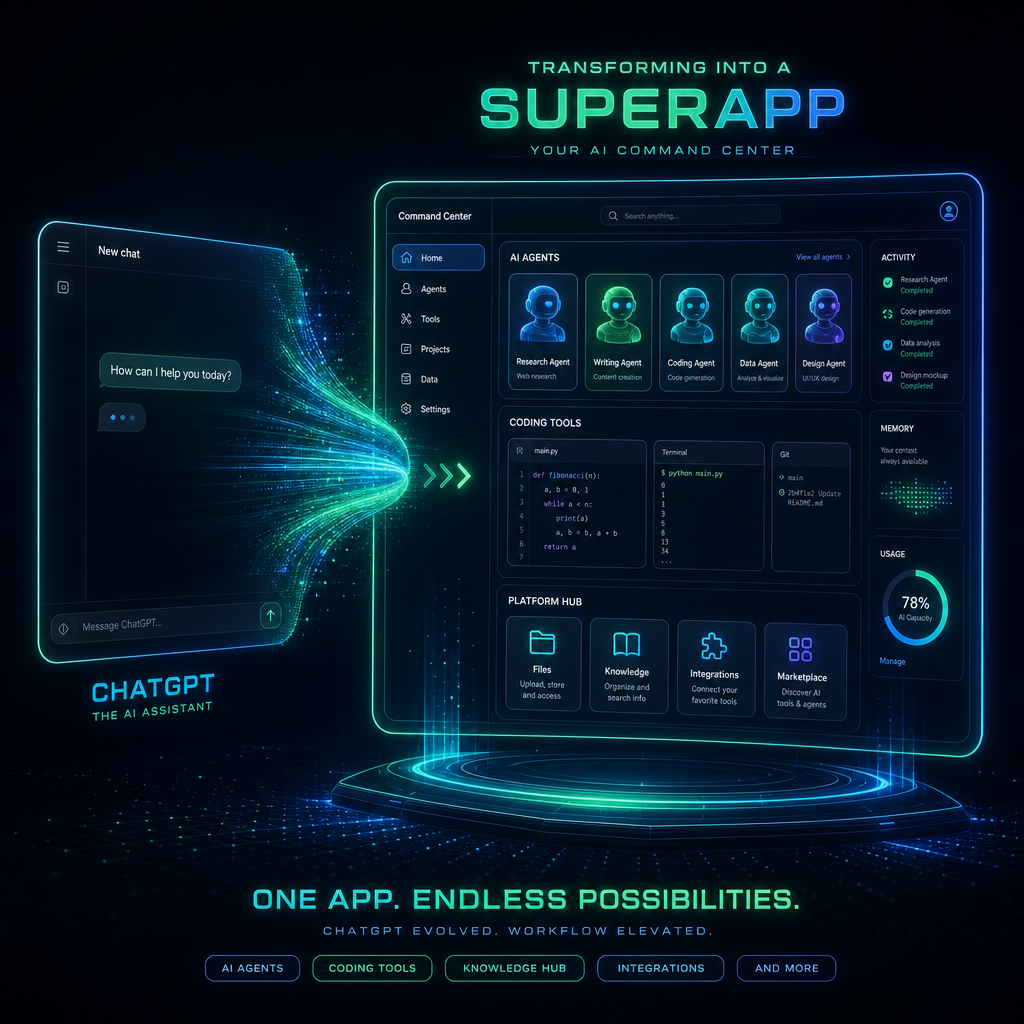
OpenAI just confirmed plans to kill the simple chatbot interface that made ChatGPT a household name and rebuild it from scratch as a superapp. The new ChatGPT will bundle coding tools through Codex, autonomous AI agents, image generation, and partner integrations from companies like Canva and Booking.com into a single, app-switching platform.
The chat window isn’t getting a facelift. It is getting replaced.
The Numbers Behind the Rebuild
The timing makes sense when you look at the business. OpenAI now serves over 900 million weekly active users, with more than 50 million paying consumer subscribers. On the enterprise side, 2 million businesses generate 40 percent of total revenue, a figure OpenAI expects to hit 50 percent by the end of the year.
An IPO filing is underway.
With those numbers, OpenAI has a user base that rivals operating systems. The problem is that a chat interface cannot monetize an operating-system-sized audience the way an app ecosystem can. Every major platform that has scaled to hundreds of millions of users has eventually pivoted to an ecosystem model. iOS had the App Store. Android had Play Store. The chat interface was the wedge, not the product.
The superapp redesign will actively steer users away from plain text conversations and toward coding workflows, agentic tasks, and third-party integrations. Think WeChat, but for knowledge work. OpenAI is not asking "how do we make chat better." It is asking "how do we become the layer everything runs through."
From Chatbots to Operating Systems
This pivot signals the most important shift in AI since ChatGPT launched: the transition from conversational AI to agent-based platforms.
A chatbot answers questions. An agent completes tasks. The distinction matters because it changes how users interact with AI, how revenue gets captured, and which businesses get built on top.
When ChatGPT was a chatbot, the value was in the conversation. When it becomes a superapp, the value moves to the actions agents execute on your behalf. Book a flight through an embedded Booking.com integration. Generate a design through Canva. Write, debug, and deploy code through Codex. Each of these becomes a surface where OpenAI can charge, partner, or take a cut.
The coding piece is particularly aggressive. Codex, OpenAI’s autonomous coding agent, already handles complex software engineering tasks. Bundling it into the core product makes every ChatGPT user a potential developer, and every developer session a retention vector. This is not incremental improvement. This is category redefinition.
Why Anthropic Forced OpenAI’s Hand
Here is the part most analysts are burying: this superapp strategy is not purely offensive. It is defensive.
Anthropic’s Claude Code has been gaining serious enterprise traction. Companies that need reliable, auditable AI for software development have been migrating. Claude’s tool use capabilities, longer context windows, and developer-first design have created a real competitive threat.
OpenAI’s response is to stop competing on chat quality and start competing on ecosystem breadth. You cannot out-chat Claude at the coding level. But you can make it so users never leave your platform because every tool they need is already integrated. That is the superapp playbook, and it is the same move Tencent made with WeChat, the same move Alipay made, and the same move every platform makes when it faces a competitor it cannot beat on a single dimension.
The AI wars just moved from "whose model is smarter" to "whose platform is stickier."
What the AI Agent Economy Demands
The shift to agentic platforms changes the economics of building in AI. When the primary interface is a chat window, your competitive advantage lives in your model’s quality. When the interface is an ecosystem of agents and integrations, your competitive advantage lives in your distribution, your partnerships, and your digital infrastructure.
For prompt engineers, AI model developers, and agent builders, this means one thing: the name you operate under matters more than ever. In an ecosystem where AI agents surface tools, services, and brands programmatically, your domain is your identity.
Generic domains like .com increasingly fail to communicate what a business actually does. A prompt engineering consultancy running on a .com looks identical to a furniture store. In an agent-driven economy where AI systems make routing decisions based on context, specificity wins.
This is exactly why .PROMPT exists. It is the native top-level domain for the AI era. If you are building agents, engineering prompts, developing AI models, or shipping tools for the agentic economy, a .PROMPT domain tells both humans and machines exactly what you do. It is a namespace designed for the ecosystem OpenAI is building.
The Window Is Now
OpenAI’s superapp is coming. Anthropic’s enterprise platform is expanding. Google’s agentic tools are shipping. The companies that build the agentic layer of the internet will define the next decade of AI.
If you are building in this space, your digital identity should reflect that. Not with a clever subdomain. Not with a generic .com that says nothing about what you build. With a domain that signals your place in the AI ecosystem from the moment someone encounters it.
Claim your AI-native identity at promptdomains.ai. The .PROMPT domain is live, and the best names are not going to last.

Leave a Reply