
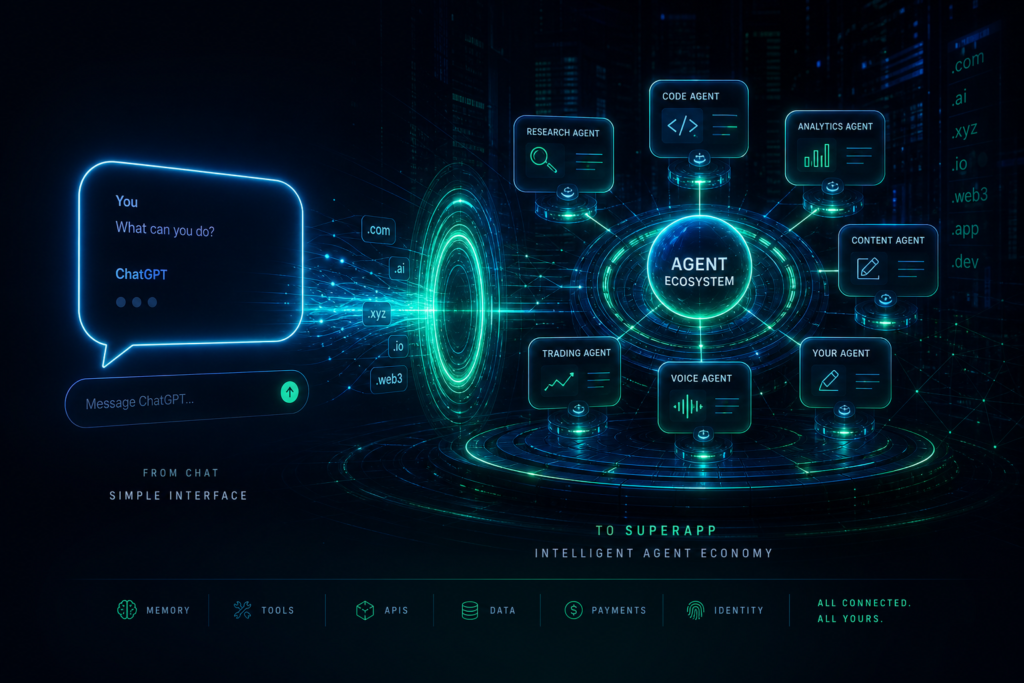
OpenAI just declared chat dead.
According to a Financial Times report, CPO Thibault Sottiaux confirmed that ChatGPT is being rebuilt from a conversational interface into a superapp, bundling coding tools, AI agents, and partner integrations with companies like Canva and Booking.com. The product will "transcend the chat surface" into a personal agent that handles tasks across work and life.
This is the biggest overhaul since ChatGPT’s 2022 launch, and it comes at a strategically loaded moment: right before OpenAI’s anticipated IPO.
But here’s what most people are missing. The real story isn’t what OpenAI is building. It’s what this shift means for everyone building around AI, from prompt engineers to Web3 founders to the people who will define digital identity in the agent economy.
From Chat Windows to Agent Orchestrations
Chat was the first interface. It trained hundreds of millions of people to interact with AI through a text box. But the text box was always a stepping stone, not a destination.
When ChatGPT becomes a superapp, it stops being a place you visit and starts being a layer that acts on your behalf. It books your travel, generates your designs, writes your code, and manages workflows across dozens of integrated tools. You don’t prompt a chatbot anymore. You delegate to an agent.
This transition from conversation to orchestration changes the fundamental unit of value in AI. It’s no longer about who has the best chatbot. It’s about who controls the agents, the integrations, and the identity layer that connects them all.
What This Means for Prompt Engineering
Prompt engineering as we know it, crafting the perfect message to extract a specific output from a language model, is about to fragment into something more complex.
In the chat era, a prompt was a single turn: input in, output out. In the agent era, prompts become orchestration instructions. They’re multi-step, context-dependent, and often embedded in workflows that span multiple tools and APIs. The "prompt" is no longer just text you type. It’s the logic that governs how agents behave, what they access, and what decisions they make autonomously.
This is already happening. Developers building with OpenAI’s API aren’t writing single prompts. They’re designing agent architectures with memory, tool use, and delegation chains. The prompt is becoming infrastructure, not interface.
For the Web3 and decentralized AI community, this creates a new category of value. If prompts are infrastructure, they need standards, ownership, and discoverability. They need namespaces. They need domains.
The Web3 Connection: Agents Need Identity
OpenAI’s superapp vision is centralized. One company controls the agents, the integrations, and the data. But the broader AI ecosystem is moving in two directions simultaneously: toward more powerful centralized platforms, and toward decentralized agent networks where AI agents operate autonomously across open protocols.
In both models, the same problem emerges: how do you identify, locate, and trust an AI agent?
A chatbot has a URL. An agent has an identity. And in a world where agents negotiate with each other, access tools on behalf of users, and represent businesses in automated workflows, that identity needs to be portable, verifiable, and human-readable.
This is where Web3 domains become critical infrastructure. A .prompt domain isn’t just a web address. It’s a namespace for the agent economy. It’s how your AI tools get found, how your agent gets trusted, and how your brand shows up in a world where the interface is no longer a browser window but a network of autonomous actors.
Domain Naming in the Agent Era
The history of the internet is a history of namespace gold rushes. When .com launched, nobody understood what a domain was for. When .io became the default for tech startups, it was because founders needed to signal what they built. When .ai took off, it was because every company suddenly needed to communicate that AI was core to their product.
The agent era demands its own namespace. And it’s arriving faster than most people realize.
Consider the naming problem OpenAI’s superapp creates. If every software tool becomes an agent integration, and every business needs an agent-accessible identity, the demand for clear, specific, AI-native domain names will explode. Generic .com domains won’t tell you what an agent does. Descriptive, AI-specific TLDs like .prompt will.
"YourAgent.prompt" tells an orchestrator exactly what it’s talking to. "YourAgent.com" tells it nothing.
As AI agents become the primary consumers of digital infrastructure, the domains that speak their language will hold disproportionate value.
What to Do Right Now
The shift from chat to agents is not a distant future scenario. It’s happening now, in OpenAI’s product roadmap, in the agent frameworks shipping from every major AI lab, and in the Web3 protocols building decentralized agent networks.
If you’re building AI tools, agent platforms, or Web3 infrastructure for the agent economy, the naming and identity decisions you make today will compound. Premium .prompt domains are how you stake your claim in the namespace that will define the next era of AI.
The chat era gave us conversational interfaces. The agent era gives us autonomous systems that need to be named, found, and trusted. That’s not a UX problem. It’s an infrastructure problem. And infrastructure is where real value lives.
Start exploring premium .prompt domains at promptdomains.ai. The agent economy is building its identity layer right now. Be early.



Leave a Reply