
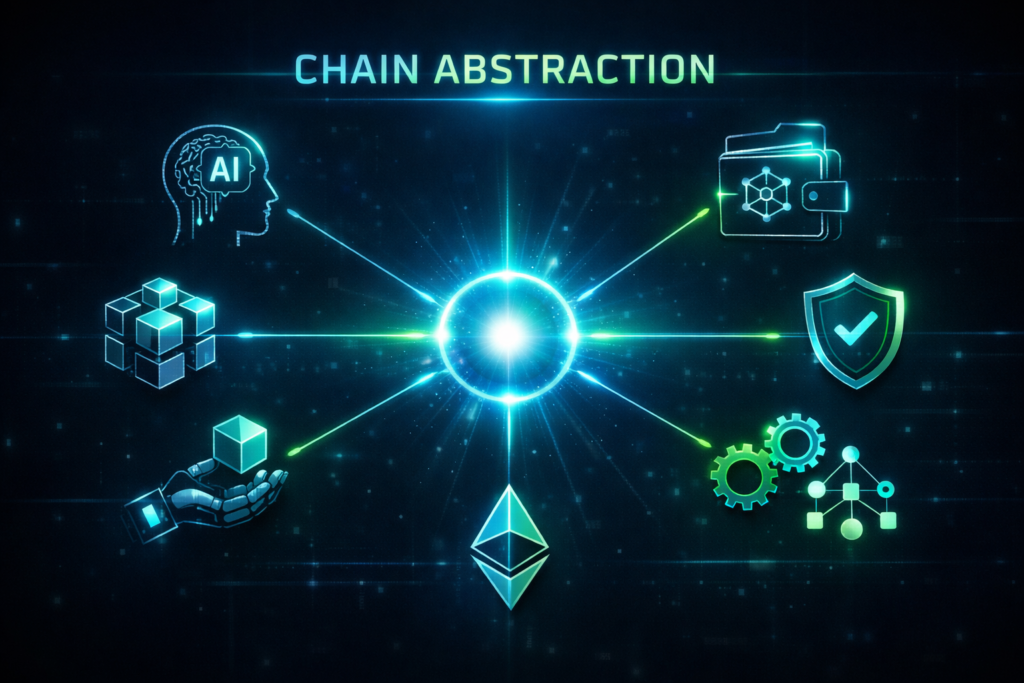
The Web3 experience has long been criticized for its “bridge and gas” friction. But a new paradigm is emerging: Chain Abstraction. This technology aims to hide the complexities of blockchains, gas tokens, and network switching, making the decentralized web as seamless as a traditional app.
The Friction Problem
Until now, using decentralized applications (dApps) required users to manually manage multiple wallets, bridge assets across chains, and hold specific tokens just to pay for “gas.” This “infrastructure tax” has been the single biggest barrier to mass adoption.
The Solution: Chain Abstraction
Chain abstraction protocols, like those recently highlighted by Phemex and new seed-funded projects like Claw Intelligence, allow the underlying blockchain to become invisible. Users interact with an interface, and the protocol handles the routing, bridging, and gas payments in the background.
Why This Matters for AI
As AI agents begin to perform autonomous transactions—buying data, renting compute, or trading assets—they cannot be bogged down by manual bridging. They need an “Intelligence Layer” that just works.
The .prompt Advantage
This is where .prompt Domains come in. As the world moves toward chain-agnostic, AI-driven interactions, your .prompt domain acts as your sovereign, portable identity. It is the human-readable handle for this abstracted future. Whether your assets are on Ethereum, Solana, or a Layer 3, your .prompt identity remains constant.
The era of manual bridging is ending. The era of seamless AI sovereignty is here.
Ready to own your piece of the AI frontier? Start your free trial at Prompt Domains today.



Leave a Reply