
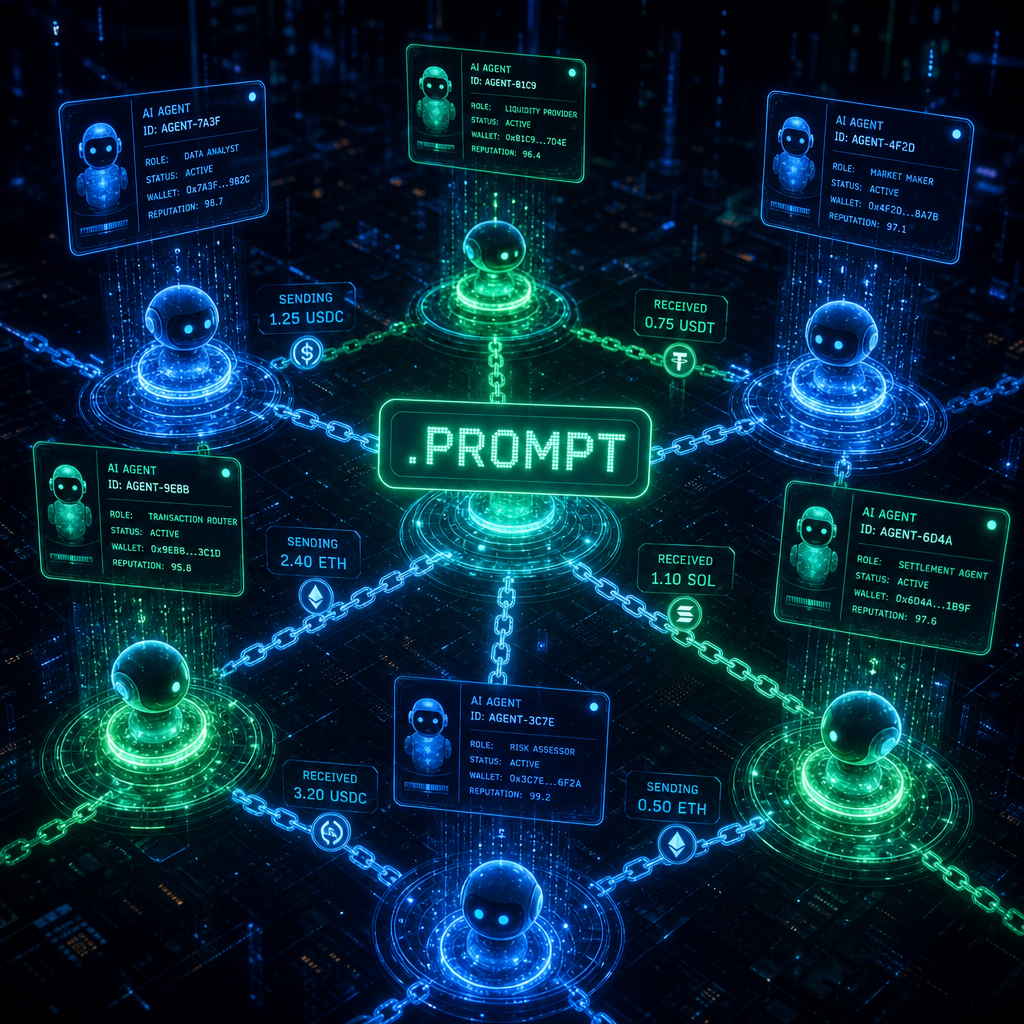
The machine economy just opened for business. As of July 2, 2026, AI agents can autonomously send and receive cryptocurrency payments without human intermediaries. This isn’t a proof-of-concept or a research paper. It’s live, production infrastructure.
CCPayment, the unified Web3 payment infrastructure for global business, launched AI Agent Payments today. The new specification enables AI agents to transact with each other through stablecoins and machine-readable integration. This is the financial layer the autonomous agent ecosystem has been waiting for.
What CCPayment Actually Launched
The AI Agent Payments product is built around three core components:
1. SKILL.md, Machine-Readable Integration
Instead of requiring developers to manually integrate payment APIs into agent workflows, CCPayment introduced SKILL.md. This is a standardized document that describes the payment API in a format AI agents can parse and execute directly. The agent reads the spec, understands the endpoints, and integrates itself. No human-in-the-loop for wiring up payment rails.
2. Permanent Deposit Addresses
Every agent gets a fixed, permanent wallet address. This means agents can receive payments reliably without generating new addresses for every transaction or session. For autonomous systems running 24/7, persistent identity at the wallet level is foundational.
3. Webhook-Driven Settlement
Payment confirmations are pushed to agents via webhooks. When a transaction settles, the agent receives a real-time notification and can trigger the next action in its workflow. This enables autonomous, event-driven financial operations at machine speed.
The system supports multiple blockchains and stablecoins, giving agents flexibility in which chain and asset they use for settlement.
Why This Matters Now
The timing isn’t accidental. Several forces converged to make this infrastructure viable in mid-2026:
Stablecoin volume has exploded. Global stablecoin transaction volume hit $33 trillion in 2025 and is on pace to exceed that in 2026. Stablecoins are already the dominant medium of exchange in crypto. They’re fast, cheap, and their value is predictable, exactly what autonomous agents need.
AI agents are already spending money. Coinbase’s AgentKit has been enabling agents to hold and transfer crypto since early 2025. Amazon Bedrock’s AgentCore framework includes agent-to-agent communication primitives. The demand side exists. What was missing was a standardized payment specification that agents could adopt without custom engineering for every integration.
Traditional payment rails don’t work for agents. Credit card networks were designed for human-initiated transactions at human speed. An AI agent running a research pipeline might need to make hundreds of micro-transactions per hour, paying for API calls, data access, compute time, and model inference. Card rails impose per-transaction fees, settlement delays, and rate limits that make this economically and technically infeasible.
Stablecoins on public chains solve the micro-transaction problem. A USDC transfer costs fractions of a cent and settles in seconds. For agents operating at machine speed, this is the only infrastructure that scales.
The Implications Are Larger Than Payments
CCPayment’s launch signals something more fundamental: AI agents are becoming economic actors with their own financial autonomy. This changes the architecture of several industries:
Web3 and DeFi
Agents can now participate in decentralized finance as first-class users. They can stake, swap, lend, and borrow autonomously. DeFi protocols built for human users will need to accommodate machine users with different risk profiles, transaction patterns, and capital efficiency requirements.
AI Platforms
Every major AI platform is building toward agentic workflows. OpenAI’s function calling, Anthropic’s tool use, Google’s Gemini extensions, they all point toward agents that act on behalf of users. Payment infrastructure is the missing layer that turns a capable agent into an economically productive one.
Gaming and Virtual Economies
In-game AI agents, NPCs with economic agency, and automated trading bots in game economies become possible when agents can transact natively. The creator economy extends to AI agents that commission work, purchase assets, and pay for services.
Enterprise AI
Companies deploying AI agents for procurement, logistics, or customer service can now give those agents direct spending authority within defined parameters. This eliminates the overhead of routing every transaction through human approval workflows.
Identity in the Machine Economy
Here’s the part most people are missing.
For AI agents to transact autonomously, they need distinct digital identities. The same way a business needs a domain to establish trust, credibility, and a verifiable presence online, an AI agent operating in the machine economy needs a way for other agents and humans to know who they’re dealing with.
A permanent wallet address is a start. But wallet addresses are opaque strings of characters. They don’t convey intent, capability, or trustworthiness.
That’s where .PROMPT comes in.
.PROMPT is the top-level domain built specifically for the AI industry. Every AI model, tool, and agent deserves a verified digital home, a domain that signals what it is, what it does, and who built it. In a machine economy where agents are making autonomous financial decisions, trust and identity aren’t optional. They’re infrastructure.
Consider an AI agent that purchases training data from another agent. Before transacting, both parties benefit from knowing the other’s identity, reputation, and capabilities. A .PROMPT domain provides that layer. agent-name.prompt tells you exactly what you’re interacting with. It’s the difference between transacting with a random wallet and transacting with a verified, identifiable counterpart.
As autonomous transactions increase in frequency and value, the agents with clear digital identities will earn more trust, attract more counterparties, and operate more efficiently. The agents without them will be treated as unverified strangers.
What Comes Next
CCPayment’s launch is one node in a rapidly forming network. The machine economy requires three layers:
- Payment rails. Stablecoins and specs like SKILL.md enable autonomous transactions.
- Identity and trust. Domains like.PROMPT provide verified, human-readable identity for agents.
- Coordination protocols. Agent-to-agent communication frameworks define how agents discover, evaluate, and transact with each other.
The payment layer just got a major upgrade. The identity layer is available now. The coordination layer is next.
For builders working on AI agents, the takeaway is clear: your agents are about to become economic participants. Give them the identity and infrastructure to operate with credibility.
Start your free .PROMPT domain trial today and establish your agent’s digital home in the machine economy.

Leave a Reply