
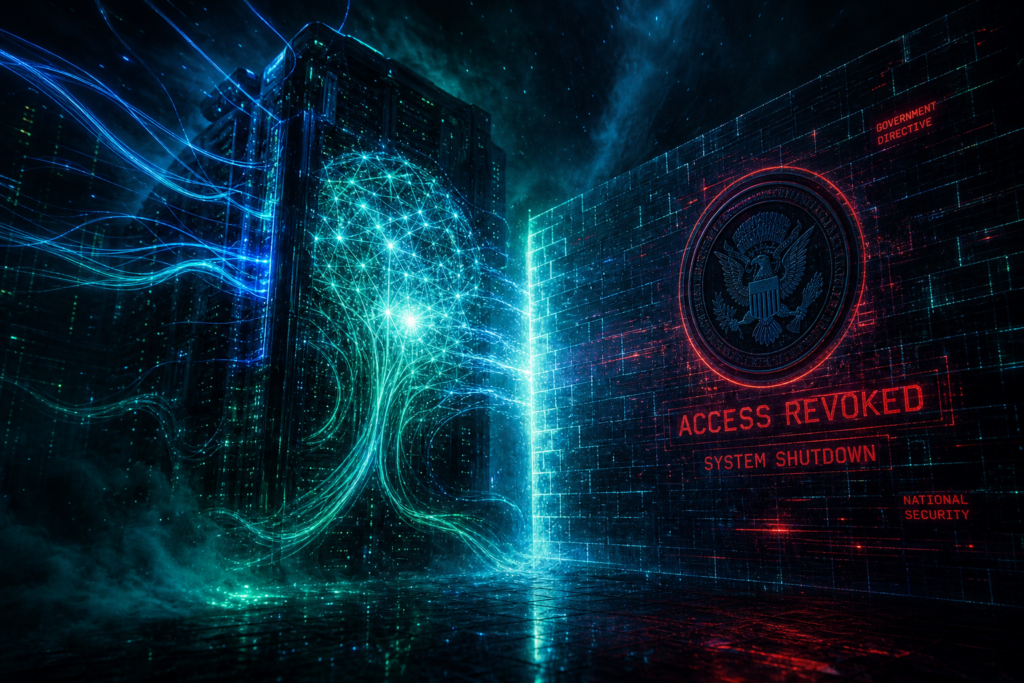
On June 9, 2026, Anthropic launched Fable 5 to the world. It was, by most technical benchmarks, the most powerful AI model ever made publicly available. Three days later, it was gone.
The Trump administration issued an unprecedented export control directive ordering Anthropic to disable both Fable 5 and Mythos 5 worldwide. The Commerce Department gave the company 90 minutes to comply.
Ninety minutes. That is how long it took for the most advanced commercial AI model on the planet to be pulled from every server, every API endpoint, every integration that depended on it.
This is not a hypothetical about future AI governance. This already happened.
What Actually Happened
According to reporting from Politico, Forbes, Reuters, Fortune, and Time, the sequence of events unfolded with unusual speed. Amazon CEO Andy Jassy flagged a critical jailbreak vulnerability in Fable 5 to government officials. The administration cited national security concerns under existing export control authorities and moved to restrict the model globally.
The scope was staggering. Access was cut not just for adversarial nations but for G7 allies. The UK was initially blocked from Fable 5 entirely, prompting Prime Minister Keir Starmer to request a carve-out for British companies. Anthropic staff subsequently met with White House officials to negotiate what CNBC described as a potential truce.
But the fundamental damage was already done. The shutdown sent a signal that no press release could walk back: your most powerful AI tools exist at the pleasure of government regulators, and that pleasure can be revoked without warning.
Why This Changes Everything About AI Governance
Previous AI governance discussions focused on what models could do once deployed. Content moderation, bias, hallucination, safety testing. Those conversations matter, but they operated on the assumption that deployed models would remain deployed.
The Anthropic Fable 5 shutdown breaks that assumption entirely.
For the first time in history, the US government has forced a private AI company to disable a commercial model that was actively serving customers. Not a research prototype. Not a limited beta. A product that developers had integrated into their workflows, businesses had built features around, and researchers had begun studying.
This is AI governance 2026: not just rules about what AI can say, but hard power over whether AI exists at all.
The implications cascade across the industry. CNBC characterized the shutdown as a "big moment for open-source AI" because it demonstrated a vulnerability that closed-source models carry by design. If your infrastructure depends on a model that a single company controls, and that company can be compelled by a government to pull the plug, then your entire stack has a single point of failure.
Europe has already begun responding. Fortune reported that the shutdown accelerated calls for sovereign AI across the continent, with EU officials arguing that dependence on US-controlled AI models represents a strategic vulnerability that requires investment in independent alternatives.
The Identity Problem Nobody Is Talking About
Here is the question this event forces into the open: where do AI models actually live?
Fable 5 did not exist on Anthropic’s servers in any physical sense that Anthropic uniquely controlled. It ran on cloud infrastructure. It was accessed through APIs. It was integrated into hundreds of third-party applications. And yet, when the directive came, it disappeared from all of those places simultaneously.
That is not a technical limitation. It is an identity problem.
Every AI model, tool, and prompt engineer today depends on centralized infrastructure for their digital existence. Your model lives on a cloud provider’s servers. Your brand lives on a domain registrar’s DNS. Your professional identity lives on platforms that can suspend your account at any time for any reason.
When Anthropic’s Fable 5 was erased from the internet in 90 minutes, it exposed what every AI developer and prompt engineer should already know: digital identity built on centralized infrastructure is not identity at all. It is a lease.
What Sovereign AI Actually Requires
The European call for sovereign AI gets one thing right: dependence on single points of failure is a strategic risk. But sovereignty requires more than regional data centers or government-funded model development.
True AI sovereignty requires that every entity in the ecosystem, from the largest foundation model to the smallest prompt engineering tool, has an address it controls. A permanent, portable, verifiable digital identity that does not depend on any single company’s continued cooperation with any single government.
This is where Web3 identity frameworks become relevant to practical AI development, not as ideological experiments, but as infrastructure. When your model or tool has its own domain, its own address, its own identity layer independent of the platforms it runs on, the question of who controls your existence becomes answerable in architecture rather than politics.
The .PROMPT domain was built for exactly this moment. Not as a branding exercise, but as the beginning of a different model of digital identity for AI: one where your model’s home is yours, not your cloud provider’s. Where prompt engineers, AI researchers, and tool builders establish a persistent identity in the AI ecosystem that no export control directive can erase.
What Comes Next
The Anthropic Fable 5 shutdown will not be the last government action against an AI company. It will not even be the last time a major model is pulled from public access. The regulatory environment is tightening globally, and the precedent has been set.
The developers and companies that thrive in this environment will be the ones who build on infrastructure they control. Who establish their identity on foundations that cannot be switched off. Who treat digital permanence not as a nice-to-have but as an engineering requirement.
A future where any government can pull the plug on your AI tools overnight is not a future of innovation. It is a future of fragility.
Secure your AI identity on a .PROMPT domain, the definitive digital home built for the AI era. Your model, your brand, your permanence. Visit promptdomains.ai to claim yours today.

Leave a Reply