
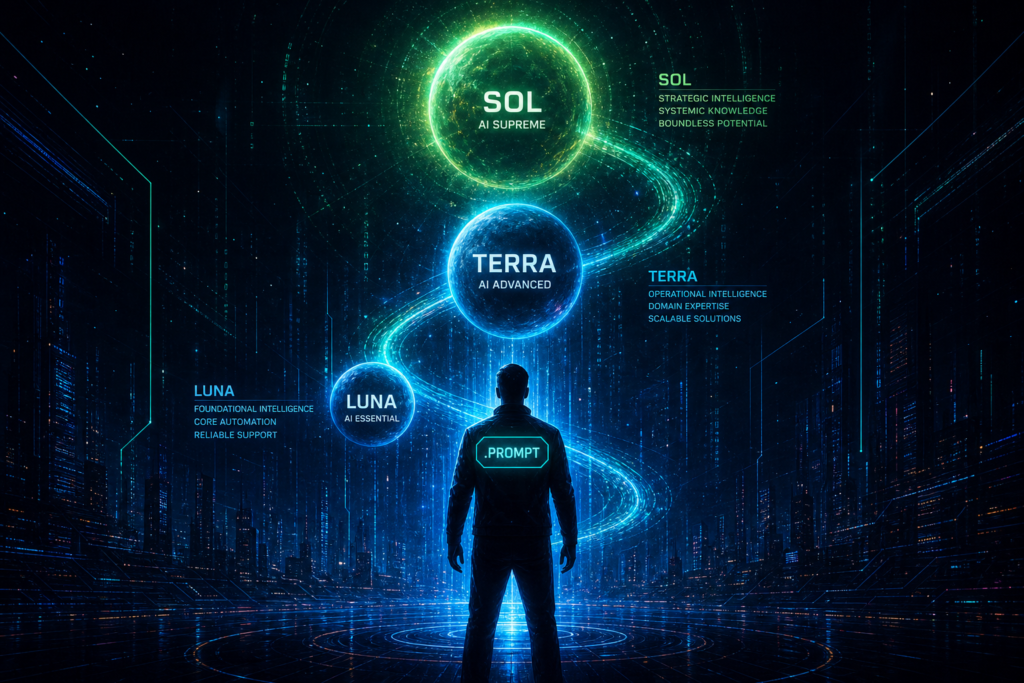
OpenAI just broke its flagship model into three. That is not a minor product update. It is a structural shift in who gets to build with frontier AI and how they will be identified in the process.
Today, OpenAI announced the GPT-5.6 model series: Sol, Terra, and Luna. Each targets a different tier of performance, cost, and use case. Alongside the model lineup, OpenAI launched GPT-Live, a voice model designed to make real-time AI conversation feel genuinely human.
The implications run deeper than pricing tiers. As AI models diversify, the developers and companies building on them need a digital identity that keeps pace.
GPT-5.6 Sol: The Flagship for Frontier Work
Sol is OpenAI’s top-tier model, priced at $5 per 1 million input tokens and $30 per 1 million output tokens. According to OpenAI’s announcement, it is 54% more token-efficient on agentic coding tasks compared to its predecessor.
This is the model for teams pushing the boundaries: complex reasoning chains, multi-step agent workflows, enterprise-grade deployments where accuracy is non-negotiable. If your work demands the highest ceiling of capability, Sol is the foundation.
For enterprises, the pricing signals something important. Frontier AI is expensive, but it is not exclusive. Sol gives organizations building mission-critical AI products a clear tier for work that justifies the cost.
GPT-5.6 Terra: The Mid-Tier That Changes the Math
Terra sits at $2.50 per 1 million input tokens and $15 per 1 million output tokens. Half the price of Sol, with performance tuned for the majority of production workloads.
This is where scale happens. Most AI applications do not need maximum reasoning power on every call. They need consistent, reliable output at a price that supports real usage volumes. Terra is designed for that middle ground: customer-facing applications, content pipelines, data processing, and the kinds of workloads that make or break unit economics.
For startups and mid-size companies, Terra lowers the barrier to building serious AI products without burning through runway on token costs.
GPT-5.6 Luna: Democratizing Access at the Economy Tier
Luna is the most aggressive move in the lineup: $1 per 1 million input tokens and $6 per 1 million output tokens. This is the tier that brings frontier AI within reach of individual developers, small teams, and experimental projects.
The democratization of AI has been a talking point for years. Luna makes it concrete. A solo prompt engineer building a specialized tool, a student prototyping an application, a small business automating workflows: these are the users who now have access to a model that would have been prohibitively expensive eighteen months ago.
OpenAI’s three-tier approach mirrors a pattern we have seen in cloud computing and SaaS: when a platform fragments into tiers, the ecosystem around it fragments too. More users, more specializations, more distinct projects, all needing distinct identities.
GPT-Live: When AI Conversations Become Human
The third announcement carries a different kind of weight. GPT-Live is a voice model that enables real-time, natural-sounding conversation with AI. OpenAI’s blog describes it as a step toward making AI interaction feel less like querying a tool and more like speaking with a knowledgeable counterpart.
Voice changes the interaction model fundamentally. When users can speak to AI naturally, the applications expand beyond text-based interfaces into customer service, accessibility, education, healthcare, and real-time collaboration. Each of those verticals requires trust, and trust starts with identity.
A voice agent representing your company needs to be identifiable, verifiable, and distinct. The domain behind that agent matters.
The Bigger Picture: Specialization Demands Identity
Here is what the GPT-5.6 launch actually represents: AI models are becoming as diverse and specialized as the people who build with them.
Sol, Terra, and Luna are not just different price points. They are different tiers of ambition. The developer choosing Luna for a side project and the enterprise deploying Sol for a production system are building in the same ecosystem, but they need to be recognized differently within it.
This is where digital identity becomes critical. When the AI space fragments into models, tools, agents, and specialized applications, a generic .com or .io domain does not communicate what you actually do. It does not tell the ecosystem you are building with AI. It does not signal your expertise to collaborators, investors, or users who are specifically looking for AI-native solutions.
A .PROMPT domain does. It tells the world exactly where you operate. Whether you are a prompt engineer shipping Luna-powered tools, an enterprise deploying Sol for complex reasoning, or a startup building the next voice application on GPT-Live, your domain should reflect the ecosystem you belong to.
Secure Your Position in the AI Ecosystem
The three-tier model is here. The voice era has arrived. The AI ecosystem is diversifying faster than any single domain convention can accommodate.
Every AI developer, prompt engineer, and AI company needs a digital identity that signals their place in this landscape. A .PROMPT domain is that signal. It is the most direct, credible way to establish yourself in the AI community.
Start your free trial and register your domain at promptdomains.ai. The ecosystem is building. Make sure your identity is ready.
Sources: OpenAI, "Previewing GPT-5.6 Sol" (openai.com/index/previewing-gpt-5-6-sol/); OpenAI, "Introducing GPT-Live" (openai.com/index/introducing-gpt-live/); CNBC reporting on the GPT-5.6 announcement.

Leave a Reply