
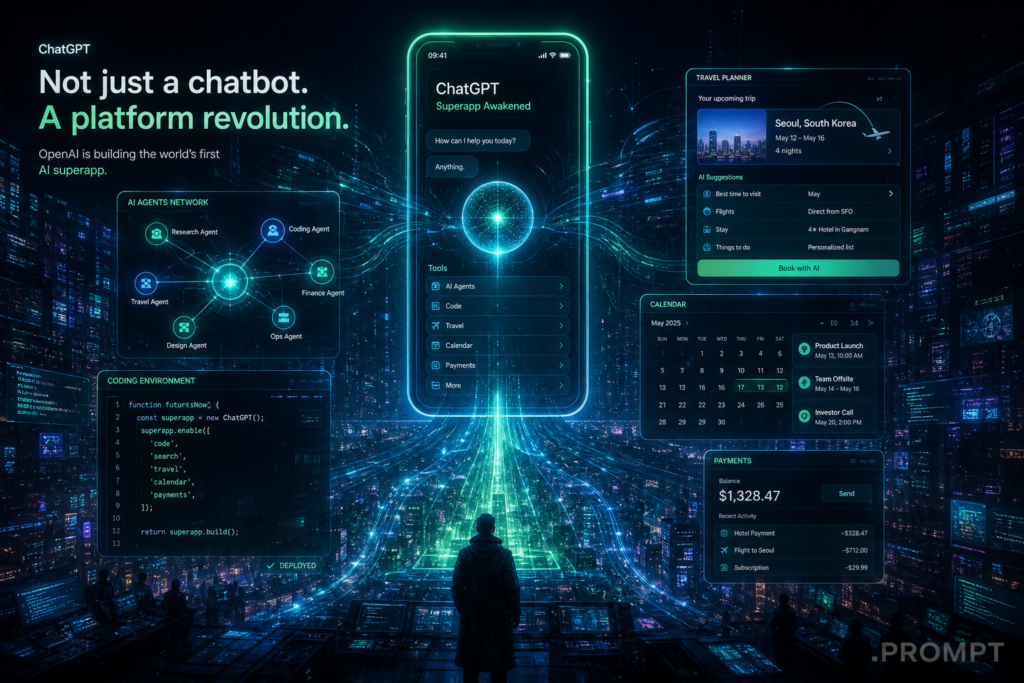
OpenAI just used the phrase "chat is dead" in internal discussions about ChatGPT’s future. Not as a joke. As a diagnosis.
According to reports from Bloomberg and the Financial Times on June 7, 2026, OpenAI is planning the most significant overhaul of ChatGPT since its launch. The goal: transform the world’s most popular AI interface from a question-and-answer chatbot into a comprehensive "superapp." Changes are rolling out in the coming weeks.
This is not an incremental update. It is a fundamental redesign of how humans interact with AI.
From Chatbot to Autonomous Agent Platform
The driving conviction behind this shift is that AI’s future does not belong to chat interfaces. It belongs to autonomous agents executing complex, multi-step tasks on your behalf.
Think beyond "write me an email." Think booking travel based on your calendar constraints, managing vendor negotiations, orchestrating multi-platform workflows without you lifting a finger. The chat window becomes a command center, not a conversation partner.
The redesign touches both the website and mobile app interface. OpenAI is building what amounts to an operating system for AI agents, and the chat input box is no longer the centerpiece.
The Numbers Behind the Pivot
This is not speculative ambition. OpenAI is making this move from a position of extraordinary scale.
ChatGPT now has over 2 million business customers, generating approximately 40% of the company’s revenue. OpenAI is targeting 50% business revenue by year-end. The enterprise machine is already running.
Codex, OpenAI’s coding tool, has crossed 5 million weekly active users, a sixfold increase. Third-party integrations with platforms like Canva and Booking.com are being embedded directly into the interface. Image generation is now native.
Meanwhile, Anthropic has filed its own IPO, valued at $965 billion. The AI industry is not slowing down to have a philosophical debate about chat interfaces. It is racing toward an agent-first future, and the biggest players are reorganizing their entire products around that bet.
Why This Matters Beyond OpenAI
Here is what most commentary will miss: when AI shifts from "chat with me" to "act for me," the entire identity layer of the internet changes.
In a chatbot world, identity is simple. You type. The model responds. There is no persistent agent working on your behalf across services, no digital entity booking flights, no autonomous system representing your interests in multi-step workflows.
In a superapp world, that changes completely.
Every AI agent acting on your behalf needs an identity. Not just a session token or an API key. A real, verifiable, persistent digital identity that other systems, platforms, and services can recognize and trust.
The prompts that drive these agents become valuable intellectual property. They are not throwaway queries anymore. They are carefully engineered instructions that orchestrate complex behaviors across multiple systems.
The Prompt Becomes the Interface
This is the shift most people are not tracking.
In a world where AI agents execute tasks autonomously, the prompt is no longer a question. It is an instruction set. A contract between human intent and machine execution. A piece of infrastructure.
Prompt engineering stops being a niche skill and becomes the core competency of working with AI. Every business deploying agents needs someone who can craft prompts that produce reliable, repeatable, high-quality outcomes at scale.
And those prompts need identity. They need provenance. They need to be traceable to their source.
Enter the .PROMPT Namespace
This is precisely the problem the .PROMPT top-level domain was built to solve.
When AI agents become autonomous actors in digital workflows, they need namespaces. They need domains. They need the same kind of identity infrastructure that websites, businesses, and brands have relied on for decades.
A .PROMPT domain does not just give you a web address. It gives you a verifiable identity in the AI-native economy. It signals that you are operating in the prompt engineering layer, that your agents and instructions are part of a recognized, trustworthy ecosystem.
Consider the landscape OpenAI is building toward: millions of business customers, millions of autonomous agents, billions of prompt-driven interactions. Every one of those interactions needs an identity anchor.
The .PROMPT namespace is positioned to be that anchor.
What to Do Now
OpenAI is not asking whether the future is agent-based. It is already building the infrastructure.
The question is whether you will have your identity established before the superapp economy goes live, or whether you will be scrambling to claim your namespace after millions of others have already staked their claims.
Chat is dead. The agent era is here. Your digital identity in that era starts with a .PROMPT domain.
Secure your namespace at promptdomains.ai.



Leave a Reply