AI just got its seatbelt.
On June 4, 2026, OpenAI rolled out Lockdown Mode to all personal ChatGPT accounts. It is not a minor settings tweak. It is a security architecture that deliberately limits what your AI assistant can do in order to protect what it can see.
If you build prompts, deploy AI agents, or integrate ChatGPT into any workflow that touches sensitive data, this changes your operating reality.
What Prompt Injection Actually Is
Prompt injection is the attack vector no one talked about two years ago and everyone worries about now. It works by embedding malicious instructions inside content that an AI model processes. A webpage, a document, a PDF, an image caption, an email thread. The model reads the hidden instruction and obeys it, often without the user ever knowing.
The consequences range from data exfiltration, where the model silently sends your conversation to an attacker’s endpoint, to content manipulation, where the model’s outputs are subtly altered to serve someone else’s agenda.
It is phishing for the AI era. Except instead of clicking a link, your model does the clicking for you.
What Lockdown Mode Actually Does
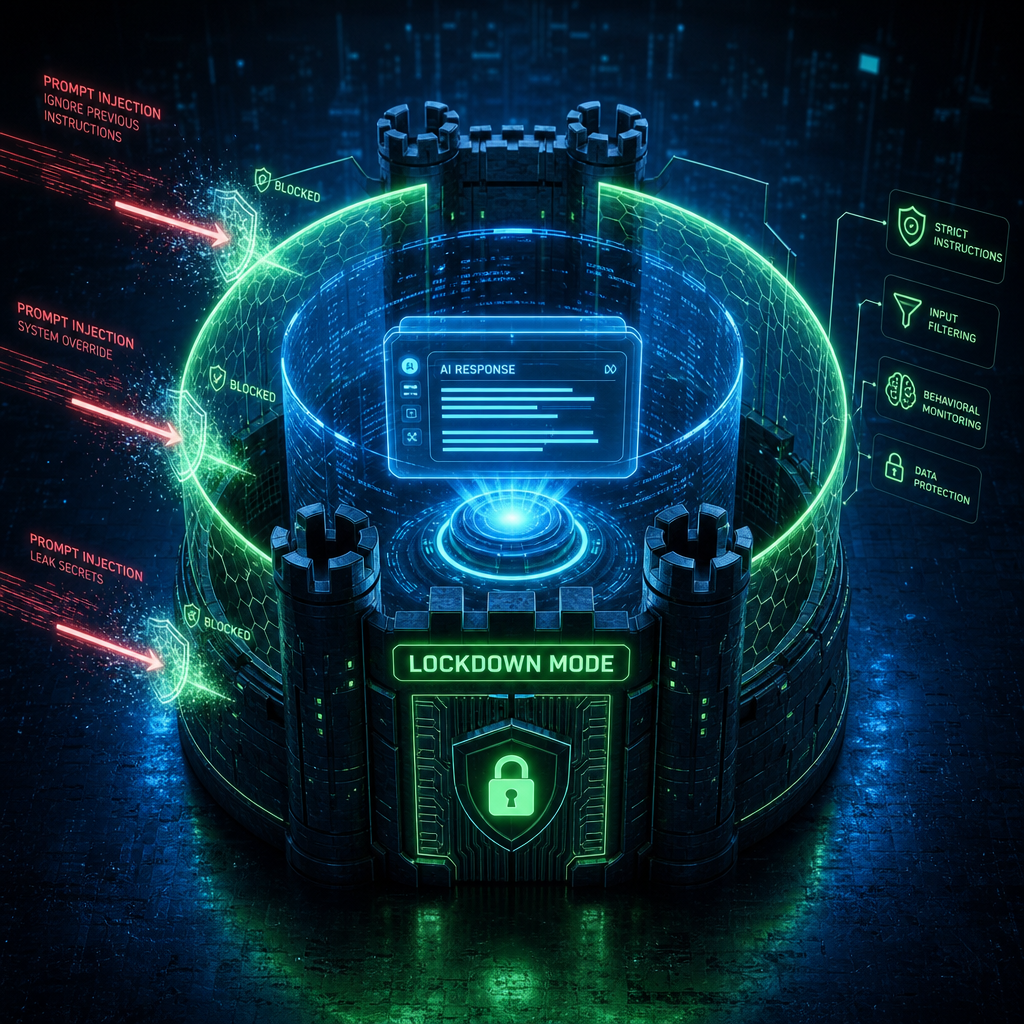
According to OpenAI’s official announcement, confirmed by Engadget and PCMag, Lockdown Mode is a toggle that restricts ChatGPT’s ability to reach outside itself. Here is what it disables:
- Live web access: The model can no longer browse the internet in real time, eliminating the most common vector for prompt injection through webpage content.
- Image from web: Generating or retrieving images from online sources is blocked, closing another injection surface.
- Deep Research: The extended research feature that pulls from multiple web sources is disabled in lockdown.
- Agent Mode: The agentic capabilities that allow ChatGPT to take autonomous actions, call APIs, and interact with external tools are turned off.
- Canvas networking: Collaborative canvas features that involve network activity are restricted.
- File downloads: The model cannot download files from the internet, preventing a key data exfiltration path.
The feature rolled out to all personal accounts on June 4, 2026. You can find it under your ChatGPT settings in the Security section. It is off by default. You turn it on when the risk profile of your work demands it.
Why This Matters Beyond the Settings Menu
The immediate implication is practical: if you are working with proprietary prompts, sensitive client data, classified workflows, or anything you would not want an attacker to extract through a manipulated webpage, Lockdown Mode gives you a kill switch for the most dangerous surface area.
But the bigger signal is what this represents.
OpenAI just acknowledged, publicly and architecturally, that the most capable AI systems are also the most exposed. The features that make ChatGPT powerful, web access, agents, research tools, are exactly the features that make it vulnerable. Security and capability are now in explicit tension.
This is not a bug. It is the new normal.
The Shift From Capability Wars to Security Consciousness
For the past two years, the AI industry competed on features. Who has the longest context window. Who can browse the web. Who has the best agent. Every new capability was a marketing win.
Lockdown Mode signals a pivot. The frontier is no longer just what AI can do. It is what AI should be allowed to do, and by whom, under what conditions.
We are entering the era of AI risk management. Prompt engineers will need to think not only about output quality, but about the security posture of every integration. AI deployment teams will need threat models, not just performance benchmarks.
This is the maturation curve every transformative technology goes through. The internet had its security reckoning. Cloud computing had its security reckoning. AI is having its security reckoning right now.
Your Identity Is the Other Half of the Equation
Security protects your work. Identity claims it.
As AI reshapes how work gets done and who gets credit for it, the prompt engineers, AI tool builders, and model creators driving this shift need more than protection. They need recognition. They need a professional identity that signals exactly what they do and positions them at the center of this emerging discipline.
This is why the .PROMPT domain exists. A .PROMPT domain is not a vanity URL. It is a professional signal. It tells the industry, your clients, and your collaborators that you operate at the intersection of AI and craft.
In a landscape where OpenAI is building walls to protect what happens inside the model, owning your identity outside the model becomes the strategic move. Security and identity are two sides of the same coin.
The engineers who take both seriously will define the next phase of this industry.
Check Your .PROMPT Domain
The namespace is live. The best names will not wait.
Visit promptdomains.ai to check available .PROMPT domains and secure your professional identity in the AI industry.
Sources: OpenAI Official Announcement (June 4, 2026), Engadget, PCMag.
Leave a Reply