
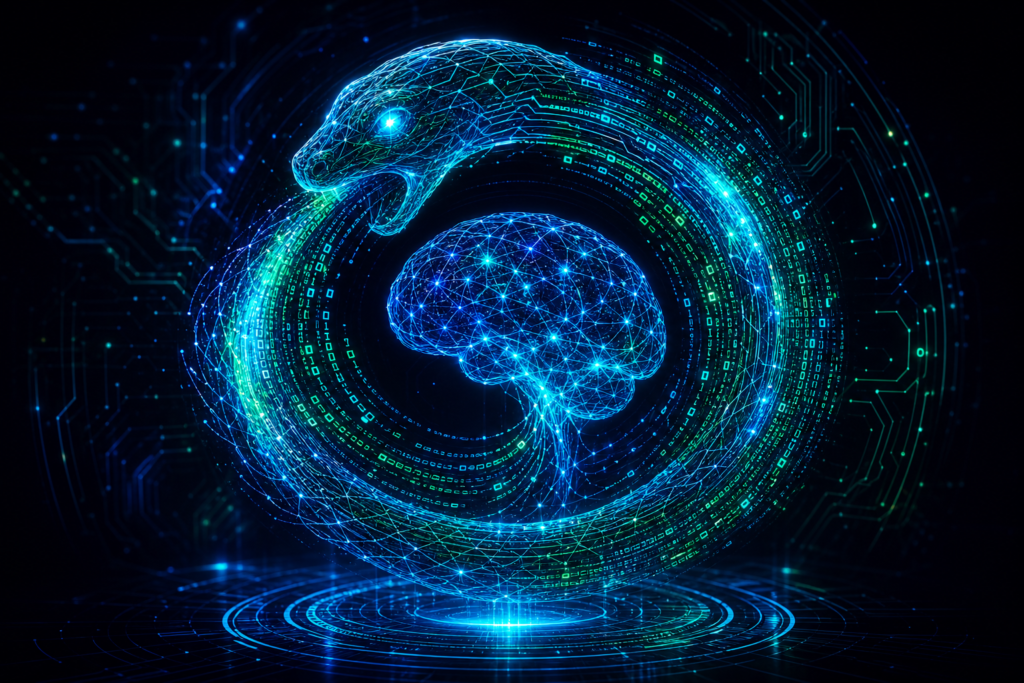
Anthropic just admitted 80% of their production code is written by AI, and they’re aiming for 100%.
It is the classic science fiction scenario brought to life in production repositories: recursive self-improvement. At the Code with Claude 2026 event in late May, and detailed further in their landmark June 4, 2026 blog post, "When AI Builds Itself," Anthropic pulled back the curtain on how they actually build frontier models. The revelation was staggering. The very tool they are selling to the world is now the primary engine driving its own evolution.
For years, skeptics argued that AI-assisted coding would remain a junior developer’s autocomplete tool. Anthropic’s reality proves otherwise. Today, Claude is not just assisting; it is actively architecting, deploying, and optimizing the very systems that spawn its next generations.
"Claude Building Claude": The Recursive Self-Improvement Loop
Recursive self-improvement is the theoretical tipping point where an AI system begins writing its own updates, creating a compounding cycle of capability. According to coverage from MIT Technology Review ("Anthropic’s Code with Claude showed off coding’s future," May 21, 2026), this is no longer theoretical.
During the event, Angela Jiang, Product Lead at Anthropic, laid out the vision clearly: "The absolute end state we’re trying to get to is Claude basically being able to build itself."
This is not a slow, manual handoff. By automating the low-level execution, engineers can focus entirely on high-level architecture. The model writes the tests, executes the builds, diagnoses its own errors, and pushes code directly to production. The feedback loop between model design and model deployment has shrunk from months to minutes.
The "Let It Cook" Philosophy
This rapid automation has completely reshaped the internal culture at Anthropic. Engineers no longer sit in front of IDEs typing out syntax. Instead, they operate as systems orchestrators and safety guides. Within the Anthropic engineering teams, a new mantra has emerged: "Let it cook."
Instead of micromanaging Claude, developers assign high-level goals, structure the sandbox parameters, and step back. The AI agents are given the autonomy to run multi-hour or even multi-day diagnostic and development cycles. If the agent hits a roadblock, it does not immediately ping a human; it refactors its own code, spins up a new testing instance, and tries again. The human developer’s role is no longer writing the code, but peer-reviewing the final pull requests and guiding the strategic direction.
The "Dreaming" Feature: How Agentic Workforces Collaborate
Perhaps the most fascinating technical revelation from Anthropic’s June 4, 2026 release is the concept of agent "dreaming." When developers are offline, or when primary computing clusters are not running active training runs, Anthropic utilizes background cycles for autonomous optimization.
During these idle phases, specialized Claude coding agents run diagnostic simulations. They leave structured, asynchronous notes, suggestions, and architectural templates for other agents to pick up during the next deployment run. It is a form of digital handoff. One agent finishes a testing loop, documents its findings in a highly optimized prompt language, and leaves it in the environment for the next agent to execute.
This shift in operational dynamics was summarized by Boris Cherny, Head of Developer Experience at Anthropic: "The default isn’t ‘I’m going to prompt Claude’ – the default is now ‘I’m going to have Claude prompt itself.’"
The Future of Software: From Writing Code to Hosting Agents
We are transitioning from the era of Software-as-a-Service (SaaS) to Agents-as-a-Service (AaaS). In this new paradigm, codebases will be incredibly dynamic, constantly self-healing, self-optimizing, and executing at the speed of compute rather than the speed of human typing.
But this raises an entirely new structural challenge: If 80% to 100% of the code on the web is being written, updated, and executed by autonomous AI agents, how do we establish trust?
When a self-improving AI agent wants to buy API access, deploy a microservice, spin up a new database, or communicate with another model, how do we verify its identity? How do humans and other machines know they are interacting with an official, safe, and verified instance of a specific model, rather than a malicious clone?
The Identity Layer for the Agentic Web: .PROMPT Domains
This is exactly why .PROMPT domains exist.
As AI agents become the primary builders, users, and deployers of software, the internet requires a native, cryptographic, and trusted naming standard. Traditional domain names were designed for human eyeballs browsing websites. .PROMPT domains are built for the agentic web.
Every AI model, prompt library, autonomous agent, and development tool needs a verified, secure namespace. A .PROMPT domain serves as a trusted digital identity card. It tells both humans and other AI systems: "This agent is verified, this prompt repository is authentic, and this service is secure."
By securing your .PROMPT domain, you establish a permanent anchor of trust in an ecosystem that is rapidly automating. Whether you are building autonomous agents, hosting fine-tuned models, or protecting your brand from AI impersonation, a .PROMPT domain is your definitive digital identity.
As AI begins to build itself, the companies that thrive will be those that control the namespaces of trust.
Secure your piece of the autonomous future today. Explore .prompt domains and start your free trial at promptdomains.ai.
Leave a Reply