
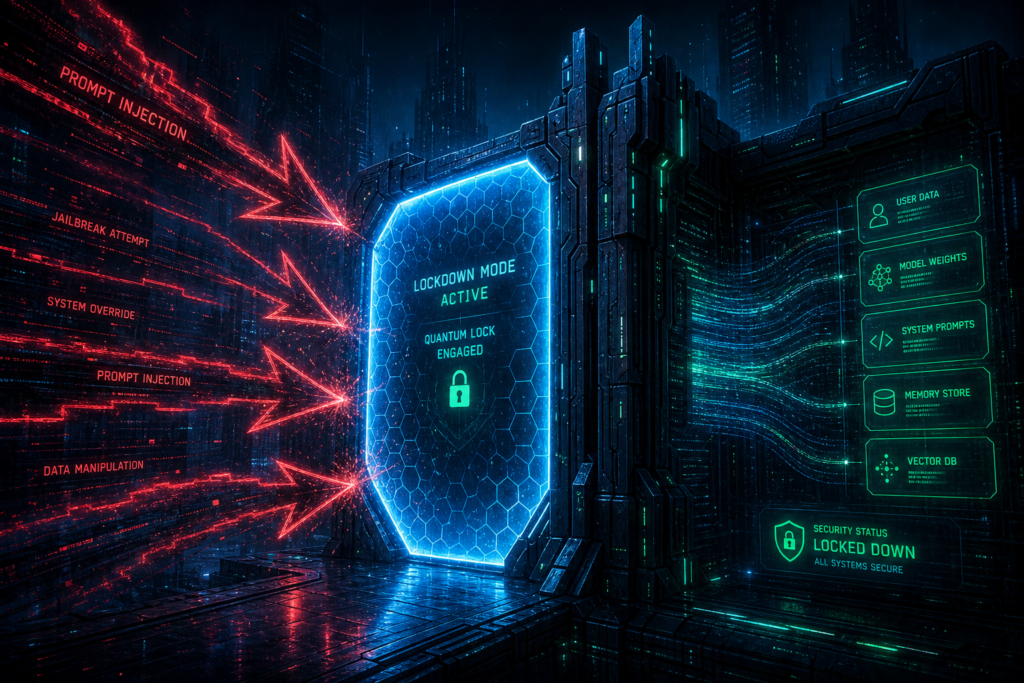
For the past two years, the entire AI industry has raced toward one goal: connect models to everything. Connect to the live web, connect to your files, connect to external tools, let agents run free. The implicit promise was that more connections meant more value.
On June 4, 2026, OpenAI drew a hard line. Lockdown Mode is now available to every personal ChatGPT account and self-serve ChatGPT Business account. It was first introduced for ChatGPT Enterprise in February 2026, but its expansion to the broader market signals something fundamental: the security paradox of connected AI has hit a wall.
The Attack Surface Problem
Prompt injection is no longer theoretical. As AI systems gain access to live web data, file systems, and agent capabilities, every connection becomes a potential vector. A cached webpage, a downloaded file, an API call to a live connector, any of these can be weaponized to manipulate model behavior in ways the user never intended.
Lockdown Mode directly addresses this by systematically disabling the highest-risk surfaces. When enabled, it turns off live web access (falling back to cached content only), removes image support in responses, disables Deep Research, shuts down Agent Mode, blocks Canvas networking and live connectors, and prevents file downloads.
This is not a minor toggle. It is a deliberate trade: sacrifice functionality for control. OpenAI explicitly positions Lockdown Mode for users with higher security needs who are willing to accept that tradeoff.
Elevated Risk Labels: Making the Danger Visible
Alongside Lockdown Mode, OpenAI introduced Elevated Risk labels for certain capabilities. This is arguably the more significant development. By tagging specific functions with explicit risk warnings, OpenAI is shifting from "here are powerful tools" to "here are powerful tools, and here is exactly where they might harm you."
This kind of transparent risk labeling does something rare in Big Tech: it educates the user instead of hiding complexity. For enterprises evaluating AI deployments, these labels become a critical input into procurement and compliance decisions.
What This Means for Enterprise AI
Lockdown Mode is a defense-in-depth response to the reality that ChatGPT is no longer just a chat interface. It is becoming an operating layer. As OpenAI rolls out agent capabilities, live connectors, and deep research features, the potential damage from a successful prompt injection attack scales with the capability of the system.
Consider a scenario: an AI agent with file access, web connectivity, and tool execution permissions encounters a malicious document. Without Lockdown Mode, the attack surface includes every one of those connection points. With Lockdown Mode, the surface shrinks dramatically.
For enterprises in regulated industries, healthcare, finance, government, this is not optional. It is the minimum viable security posture for production AI deployments.
The Broader Implication for Builders
If you are building on connected AI systems, whether as a developer, a prompt engineer, or an AI-native startup, Lockdown Mode forces a reckoning. The assumption that more connectivity always equals better outcomes is now officially contested by the platform providing the connectivity.
This creates a new design constraint. Building AI products means building for a world where users will, and should, disable features that create risk. The secure-by-default architecture wins.
For Web3 builders and domain investors, this moment underscores a larger truth: digital identity and security infrastructure will define the next phase of the AI-powered internet. The models are getting more powerful, but power without trust is liability.
Looking Forward
OpenAI will likely iterate on Lockdown Mode. More granular controls, per-feature toggles, enterprise policy integration, all are probable. But the direction is set. The era of "connect everything, figure out security later" is over.
For anyone navigating this shift, the fundamentals remain constant: own your identity, secure your infrastructure, and build on foundations that scale with trust.
At Prompt Domains, we help domain investors and Web3 builders secure their position in the AI-powered future through premium domain names and digital identity infrastructure. The .PROMPT top-level domain is built for this exact moment, where identity, security, and AI converge.
The future belongs to those who build it securely.



Leave a Reply