
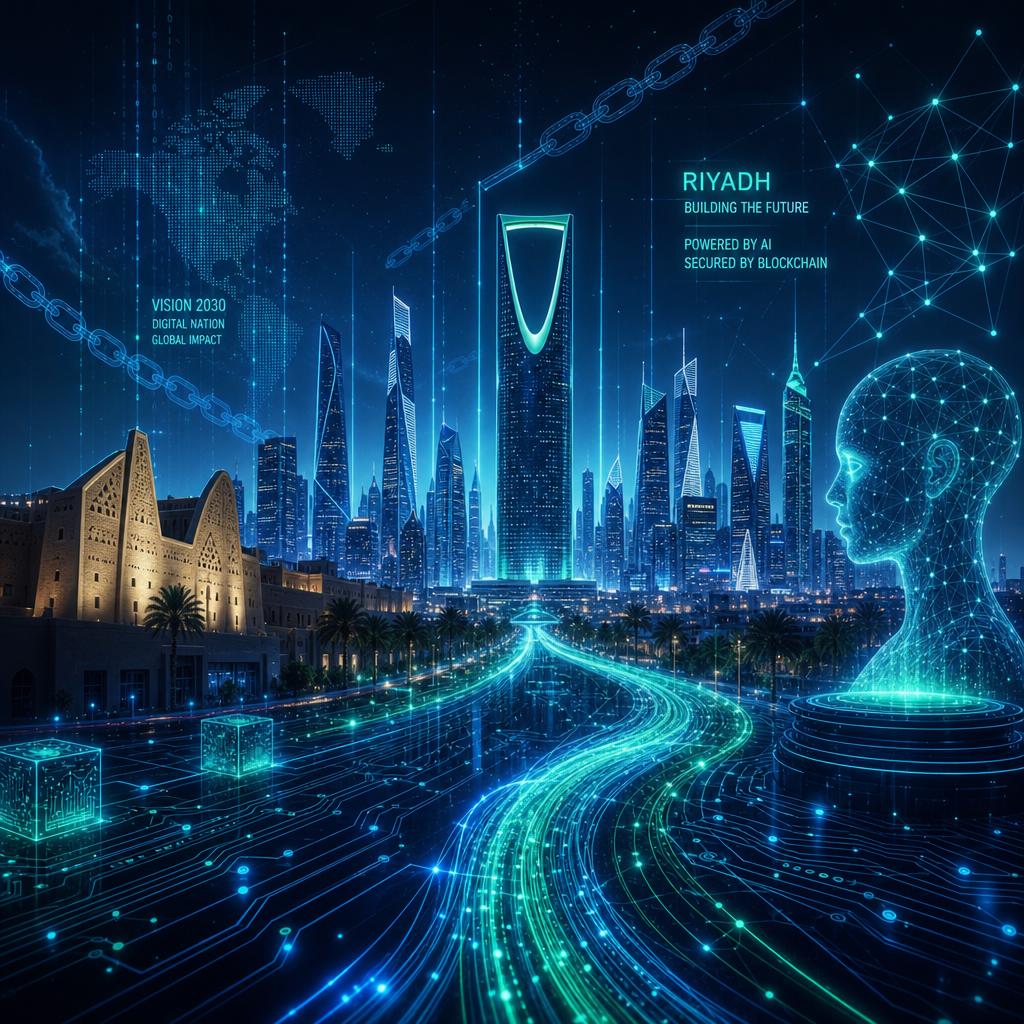
Riyadh is no longer just an oil capital. Over the last week, the city cemented itself as a global nexus for AI and blockchain infrastructure, and the implications reach far beyond the Kingdom’s borders.
The Global Blockchain Show Riyadh, held June 29-30, 2026, drew 6,723 attendees from over 80 countries, with 15,000+ registrations and a speaker roster exceeding 100 global leaders. Organized by VAP Group and powered by Times Of Blockchain, the event ran alongside the Global AI Show Riyadh and the Global Games Show Riyadh, creating one of the largest combined technology gatherings of the year. Perhaps the most telling metric: 70% of attendees held CXO-level titles. This was not a tourist event. It was a boardroom convening on a national scale.
And Riyadh wanted the world to notice.
The Invisible Blockchain: The Real Breakthrough
While tokenization, DeFi, and enterprise infrastructure dominated the headlines, the concept gaining the most traction behind closed doors was what speakers called "invisible blockchain", the idea that the most successful blockchain infrastructure will be the kind users never see.
Gasless transactions. Streamlined onboarding. Zero friction at the interface layer. Chain abstraction, the architectural pattern that hides the complexity of multi-chain interactions from the end user, moved from theoretical framework to deployment priority. The implication is profound: when blockchain becomes invisible, it becomes ubiquitous.
Meow, Co-Founder of Jupiter, one of the largest decentralized exchanges in the Solana ecosystem, framed the DeFi-CeFi convergence as an inevitability rather than a possibility. The distinction between centralized and decentralized finance, he argued, is dissolving as infrastructure matures and user experience converges with traditional financial platforms. That convergence, paired with invisible infrastructure, creates the conditions for blockchain to finally reach the mainstream audience that has eluded it for over a decade.
Where AI Meets Web3
The co-location of the AI and blockchain shows was not a logistical convenience. It reflected a structural reality: AI and Web3 infrastructure are no longer parallel tracks. They are merging.
AI models need verifiable data provenance. Blockchain networks need intelligent automation. Tokenized ecosystems need AI-driven analytics for risk, compliance, and optimization. The speakers who drew the loudest responses were not the ones talking about tokens or L2 scaling. They were the ones demonstrating how AI agents interact with smart contracts, how decentralized identity layers secure AI model interactions, and how enterprise blockchain infrastructure enables the trust frameworks that AI deployment demands.
This convergence changes the calculus for every builder in the space. If you are building an AI product, you need a Web3 identity layer. If you are building on-chain infrastructure, you need AI-native tooling. The question is no longer whether these worlds will merge. The question is whether you are positioned for the merge when it accelerates.
Riyadh as the Sandbox
Saudi Arabia’s bet on technology infrastructure is not new, but the scale of the Global Blockchain Show signals something different. Riyadh is positioning itself as a global sandbox, a regulatory and infrastructural environment where blockchain and AI innovation can operate at scale with enterprise-grade governance.
VAP Group reinforced this by launching VAP Ventures, a dedicated fund targeting 100 startup investments by 2030. With 100 exhibitors showcasing solutions spanning decentralized finance, digital identity, cybersecurity, and tokenized ecosystems, the event demonstrated that Riyadh is not just hosting the conversation. It is funding it, building the infrastructure for it, and demanding a seat at the table where the next generation of Web3 and AI standards are written.
The 80+ countries represented, the CXO-heavy delegation, and the co-located AI and blockchain programming all point to one conclusion: Riyadh has entered the global tech infrastructure race, and it is running at full speed.
What This Means for Your Digital Identity
Here is what the mainstream coverage will miss: every one of these trends, invisible blockchain, AI-Web3 convergence, tokenized ecosystems, decentralized identity, converges on a single foundational requirement. Digital identity.
Your AI model needs a verified identity. Your blockchain project needs a trusted, recognizable digital home. Your company, operating at the intersection of AI and Web3, needs a domain that signals exactly what you do and where you operate.
The .com era is not over, but it is no longer sufficient. In a world where 6,723 senior leaders gather in Riyadh to build the next layer of decentralized infrastructure, the domains that carry the most authority are the ones that reflect the technology itself. A .PROMPT domain tells the market immediately that you are building in AI. That you understand the infrastructure. That your digital identity is as intentional as your technology stack.
Prompt Domains exists for this moment. As blockchain infrastructure matures, as AI and Web3 converge, and as the digital economy demands more precise, trustworthy identity layers, owning a premium domain in the .PROMPT namespace is not a nice-to-have. It is a strategic decision.
The future of the internet is being built in places like Riyadh, on infrastructure that is invisible by design, powered by AI that demands verified identity. Your domain should reflect that reality.
Visit promptdomains.ai to secure your .PROMPT domain and establish your digital identity in the ecosystem that matters.
Source: The Global Blockchain Show Riyadh (June 29-30, 2026), as reported by Blockchainreporter/MEXC News.


Leave a Reply