
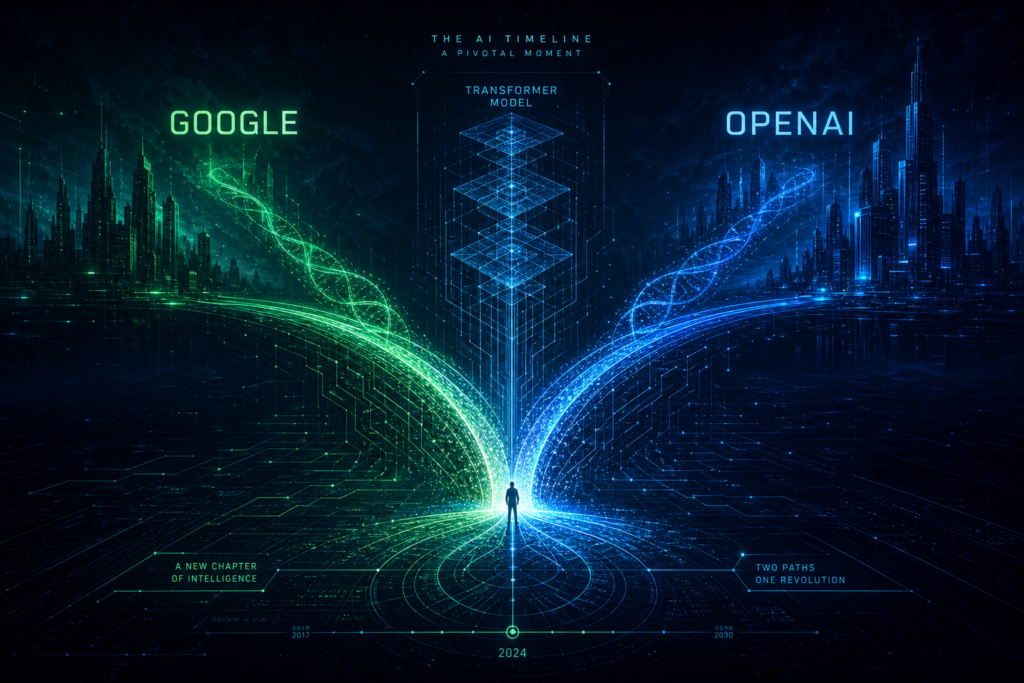
Noam Shazeer just left Google for OpenAI. If you build AI, build with AI, or build for AI, this is the single most important personnel move of 2026. And it has nothing to do with compensation packages.
It has everything to do with identity.
Who Is Noam Shazeer?
Noam Shazeer is not just another senior engineer hopping between FAANG campuses. He is one of the original architects of the modern AI era.
In 2017, Shazeer co-authored "Attention Is All You Need," the research paper that introduced the Transformer architecture. That paper is the "T" in GPT. It is the foundation of every large language model in production today. Gemini, Claude, Llama, Mistral, Grok, every model your product depends on exists because of the architecture Shazeer helped create.
He spent roughly 20 years at Google. He co-led the development of Gemini, Google’s flagship multimodal model. He was, by any measure, one of the most consequential people in the building.
Then he left to start Character.AI. Google paid approximately $2.7 billion in a reverse acqui-hire to bring him back. Less than two years later, he is walking away again, this time to OpenAI.
The pattern is the signal.
Why This Move Matters Beyond Headlines
When someone who could work anywhere chooses to move, it reveals where the center of gravity is shifting. Shazeer’s departure from Google to join OpenAI is not a story about one person. It is a story about convergence.
The AI talent war has been discussed abstractly for years. Salaries, equity, compute access, research freedom. Those factors matter. But Shazeer’s move exposes something deeper: the most important minds in AI are no longer optimizing for stability or resources. They are optimizing for proximity to the frontier.
OpenAI is preparing for what could be the largest technology IPO in history. Reuters reported the move first, with The Verge, TechCrunch, and TNW confirming details throughout the day. The timing is not coincidental. The best researchers are positioning themselves at the center of the next wave, not riding out the current one.
For Google, the loss is significant but not fatal. Gemini has momentum. The team Shazeer helped build continues to ship. But the symbolism matters. When the person who co-invented the foundation of your competitor’s technology chooses to work there, it tells you something about where the frontier is moving.
For OpenAI, it is a declaration of intent. This is not a defensive hire. This is an offensive one. Shazeer does not fill a gap. He accelerates a trajectory.
The Talent War Is Actually an Identity War
Here is what most commentary on this story will miss.
Every major shift in technology produces a parallel shift in identity. The companies that define the era do not just build the technology. They own the narrative. They define what it means to be part of the ecosystem.
When mobile computing became the dominant paradigm, the companies that thrived were the ones that signaled mobile-first. Not just in their product, but in their brand, their domain, their presence. A .mobi domain was an early signal. An app store presence became the defining identity marker. The companies that ignored those signals got left behind.
AI is undergoing the same identity crystallization right now.
The companies, tools, models, and engineers building the AI ecosystem are in a race not just to ship, but to signal. To declare where they stand. To make their allegiance to the AI future visible and permanent.
A .com tells you nothing about what a company does. A .io hints at tech, but it is generic. An .ai narrows it, but it has become crowded and diluted. Every AI wrapper, every prompt library, every model fine-tune claims the .ai namespace.
The .PROMPT domain is different. It is purpose-built for the AI ecosystem. When a model, tool, or engineer uses a .PROMPT domain, the namespace itself communicates expertise. It says: this is not a side project. This is not a feature. This is AI-native identity.
What Shazeer’s Move Teaches Every AI Builder
Noam Shazeer did not leave Google because Google is failing. He left because the center of gravity shifted. He followed the energy, the talent, and the frontier.
The same logic applies to how you position your AI brand.
If you are building an AI model, a prompt engineering practice, an AI consulting firm, or a tool that serves the AI ecosystem, your digital identity should reflect that. Not vaguely. Not generically. Precisely.
A .PROMPT domain is a declaration. It tells the market, your users, and your peers exactly what you are and what you build. In a landscape where thousands of companies are scrambling to signal AI relevance, a purpose-built domain cuts through the noise.
Shazeer’s career is a masterclass in positioning. Every move he has made has been a signal about where he believes the future lives. Your domain choice works the same way. It is not vanity. It is positioning. It is the first impression that shapes every interaction.
The Bottom Line
The AI talent war is real, and Noam Shazeer’s move to OpenAI is its most visible chapter yet. But the deeper story is about identity: who claims their place in the AI ecosystem, and how.
The builders who shape this era will not just ship great models and tools. They will own their identity in the ecosystem. They will make their position visible, credible, and permanent.
A .PROMPT domain is how you do that.
If you are building something in AI, claim your place. The ecosystem is forming now, and the namespaces that define it are being claimed in real time. Visit promptdomains.ai to see what is available.
Sources: Reuters, The Verge, TechCrunch, TNW (June 18, 2026)


Leave a Reply