

OpenAI just gave free ChatGPT users a powerful new defense against prompt injection. But securing the chat interface is only half the battle.
On June 4, 2026, OpenAI rolled out Lockdown Mode to personal and self-serve Business accounts. Previously reserved for Enterprise and Education tiers, this optional security setting is now available to anyone who navigates to Settings > Security and flips the switch.
When enabled, Lockdown Mode systematically disables the features that make AI assistants most useful, and most vulnerable. Live web access goes dark. Image support in responses is blocked. Deep Research, Agent Mode, Canvas networking, and live connectors all shut down. File downloads are restricted. Every capability that creates a pathway between your AI and the outside world gets sealed off.
The reason is prompt injection, the attack vector that security researchers have been warning about since large language models went mainstream. In a prompt injection attack, malicious instructions are hidden inside web pages, documents, or images that an AI agent encounters during a task. The AI processes the hidden instructions as if they were legitimate commands, potentially exfiltrating sensitive data from the user’s session to an attacker-controlled endpoint. Lockdown Mode eliminates these pathways by removing the integrations that make exfiltration possible.
This is not a niche concern. As AI agents gain the ability to browse the web, execute code, connect to APIs, and interact with files, the attack surface expands with every capability. OpenAI’s decision to offer Lockdown Mode to all users signals something important: the industry is no longer treating AI security as an afterthought. Trust is becoming the currency that separates viable AI products from dangerous ones.
The Maturation Curve of AI Security
Consider the timeline. Eighteen months ago, prompt injection was a research paper topic. Twelve months ago, it was a bug bounty discussion. Today, it is a feature-level security toggle inside the world’s most popular AI product. That acceleration tells you everything about how quickly the threat landscape is evolving.
OpenAI is not alone in this shift. Anthropic has invested heavily in constitutional AI frameworks designed to prevent models from following adversarial instructions. Google DeepMind has published extensive research on jailbreak detection. The pattern is clear across every major lab: as AI capabilities grow, the security infrastructure must grow faster.
Lockdown Mode represents a specific philosophy. Rather than trying to make AI models invulnerable to every possible attack, it gives users explicit control over their risk surface. You choose how much connectivity your AI agent has, and therefore how much exposure it carries. It is an admission that the safest AI is the one with the fewest external connections, and that users should decide where that line falls.
This is a mature approach. It acknowledges a fundamental tension in AI design: capability and security exist in direct opposition. Every feature that makes an AI agent more powerful also creates a new potential attack vector. Lockdown Mode does not resolve that tension. It manages it.
Securing the Conversation Is Not Enough
Lockdown Mode protects the chat interface. It limits what your AI can do during a session. But it does not address a deeper vulnerability: the identity layer.
Think about what happens outside the chat window. Your AI tools have names. Your prompts have destinations. Your agents interact with external services that need to verify they are communicating with the real thing, not an impersonator. In a world where prompt injection can hijack AI behavior, the question of identity verification is not theoretical. It is urgent.
When an AI agent sends a request to an external API, how does that API know the request is legitimate? When a prompt engineer publishes a tool or a resource, how do users verify it originated from a trusted source? When an organization deploys an internal AI workflow, how does it establish a verified namespace that cannot be spoofed by attackers?
These are identity questions, and they require identity infrastructure.
The .PROMPT Namespace as a Trust Layer
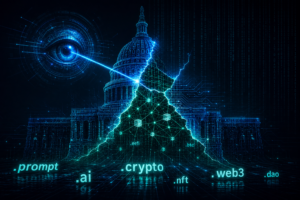
This is where the next frontier of AI security begins. A .PROMPT domain is not just a web address. It is a verified namespace purpose-built for the AI ecosystem.
In the traditional web, domain extensions like .com and .org carry implicit meaning. A .edu signals an educational institution. A .gov signals a government entity. These extensions function as trust markers, allowing users and systems to make rapid assessments about the source they are interacting with.
The AI ecosystem needs the same kind of trust infrastructure, but optimized for its unique requirements. When a prompt engineer registers a .PROMPT domain, they are not simply claiming a URL. They are anchoring their AI identity in a namespace that signals authenticity, specialization, and intent. Other AI tools, agents, and systems can recognize a .PROMPT domain as belonging to the prompt engineering ecosystem, creating a foundation for verified communication between AI services.
Consider a concrete scenario. An enterprise deploys an AI agent that connects to multiple external services. Each service needs to verify the agent’s identity before processing requests. Without a standardized identity layer, each connection requires custom verification logic, API keys, and trust configurations. A .PROMPT domain simplifies this by providing a recognizable, consistent identity marker that external services can validate through standard DNS mechanisms.
This is not speculation. It is the logical extension of what OpenAI is building with Lockdown Mode. If the industry is investing in securing the conversation, the next step is securing the identities that participate in those conversations.
Trust Is the New Attack Surface
The cybersecurity industry learned this lesson decades ago. Perimeter defense is necessary but insufficient. You also need identity management, access control, and verified communication channels. AI security is following the same trajectory, compressed into a fraction of the time.
Lockdown Mode is perimeter defense for your AI session. A .PROMPT domain is identity infrastructure for your AI presence. Together, they represent a more complete security posture, one that addresses both the conversation and the participants in it.
OpenAI’s move on June 4 was a signal. The AI industry is maturing past the phase where raw capability was the only metric that mattered. Trust, verification, and identity are becoming the competitive differentiators that determine which AI tools enterprises adopt, which prompt engineers build on, and which platforms users choose.
Your prompts deserve a home as secure as your conversations. Claim your .PROMPT domain today and anchor your AI identity in a namespace built for trust.


Leave a Reply