
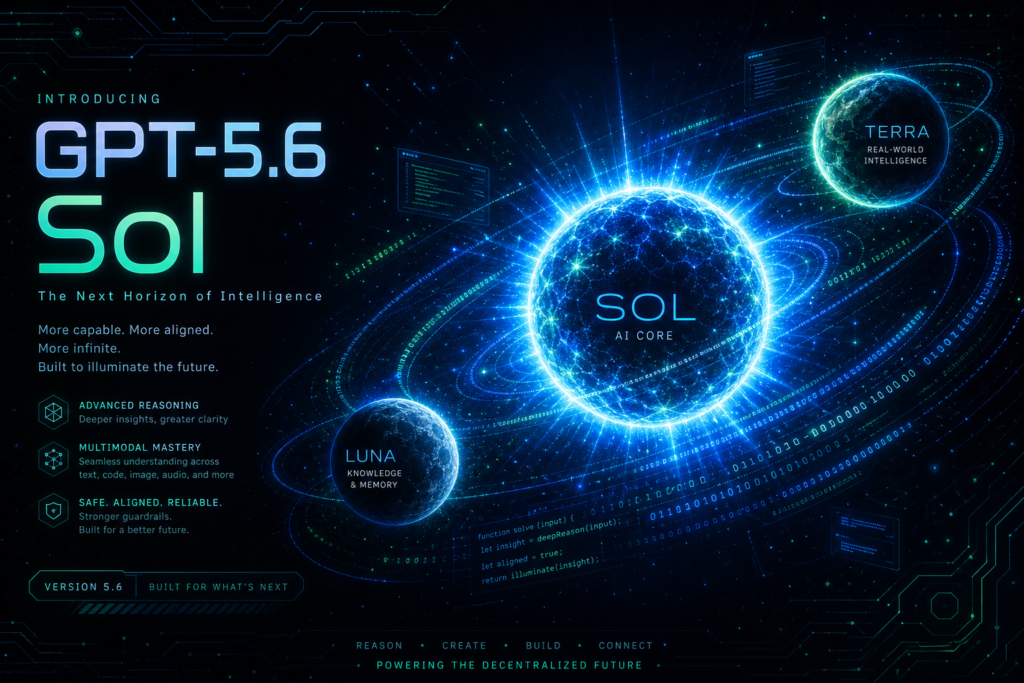
Today, OpenAI dropped not one but three new foundation models, and the implications go far beyond faster chatbots. With GPT-5.6 Sol, Terra, and Luna, the company has built a tiered intelligence stack designed to serve everyone from government agencies to solo developers. And for anyone building in Web3, the message is clear: the era of truly agentic AI has arrived, and it is going to reshape how we own, build, and interact with the internet.
Let’s break down what landed, what it means, and why it matters for your digital identity.
The Sol, Terra, Luna Model Family: A New Tier of Intelligence
OpenAI has moved beyond a single flagship model. GPT-5.6 Sol is the top-tier powerhouse, built for complex, multi-step tasks with groundbreaking agentic capabilities in coding, biology, and cybersecurity. It introduces two new reasoning modes: "max" for extended, deliberate problem-solving, and "ultra" mode, which leverages subagents to decompose and tackle problems of extraordinary complexity.
Terra is the workhorse, positioned as the intelligent mid-tier. It delivers performance competitive with the previous generation (GPT-5.5) at roughly half the cost, making sophisticated AI accessible for a wider range of applications.
Luna is the speed demon, the most affordable and fastest of the three, designed for high-throughput, low-latency tasks where raw speed and cost efficiency are paramount.
This three-tier approach isn’t just about pricing; it’s about matching the right model to the right job, a critical evolution as AI moves from being a conversational tool to an active participant in digital workflows.
Capabilities: What Sol’s "Ultra" Mode Actually Does
The headline feature of GPT-5.6 Sol is its agentic architecture. With "ultra" mode, Sol doesn’t just process a prompt; it can spawn subagents to research, verify, and execute sub-tasks autonomously. In early benchmarks, this has translated to significant leaps in code generation, vulnerability analysis, and complex scientific reasoning.
This is not incremental improvement. It is a step change in what an AI model can do as a primary actor in a digital system. OpenAI’s commitment to safety was underscored by over 700,000 A100-equivalent GPU hours dedicated to automated red-teaming before this release.
The Government Angle: A Signal of AI’s Strategic Importance
The rollout is a limited preview, starting with trusted partners and coordinated with the US government. This detail is not a footnote. It signals that frontier AI models are now considered critical national infrastructure, subject to a level of oversight and deployment strategy previously reserved for defense and energy systems.
For builders, this means access to the most powerful tier may come with new compliance considerations. For the broader market, it confirms that AI governance is now an operational reality, not a future debate.
Pricing: A Framework for Enterprise and Developer Adoption
The pricing structure is deliberate and telling:
- GPT-5.6 Sol: $5 per 1M input tokens / $30 per 1M output tokens
- Terra: $2.50 / $15
- Luna: $1 / $6
This tiered pricing accelerates adoption across the stack. Enterprises can reserve Sol for mission-critical, agentic workflows. Developers can build on Terra for robust performance at scale. High-volume applications, from real-time analytics to decentralized network orchestration, can leverage Luna’s speed and cost point. The launch on Cerebras hardware, pushing up to 750 tokens per second, further emphasizes the focus on real-time, agentic performance.
The Web3 Implication: Agentic AI Meets Decentralized Systems
Here is where it gets critical for the Web3 native.
The most profound impact of models like GPT-5.6 Sol is their potential to act as autonomous agents within decentralized systems. An AI with Sol-level reasoning can analyze a smart contract for vulnerabilities, negotiate terms in a decentralized autonomous organization (DAO), execute complex cross-chain transactions based on real-time data, or manage an entire portfolio of on-chain assets according to a high-level strategy.
This is the bridge between traditional AI and the programmable economy of Web3. The models are becoming the intelligent operators, and blockchain is becoming their trusted, immutable execution layer. As AI models become the primary way we interact with digital services, the infrastructure they need to identify and authenticate themselves becomes paramount.
Your Digital Identity in the AI-Native Internet
This shift raises a fundamental question: In an internet where AI agents are first-class citizens, what does your identity look like?
Generic, legacy domains are not built for this world. They were designed for a human reading a webpage, not for an AI parsing a digital identity and reputation. The new internet needs new primitives.
A .prompt domain is more than a URL. It is an AI-native address. It signals that your digital presence is built for the agentic web, understood by both humans and machines. As models like GPT-5.6 redefine interaction, a .prompt domain becomes your verifiable stake in the future of AI-driven web interaction. It is the foundation for digital identity in Web3, a clear signal to the next generation of intelligent systems.
Claim Your AI-Native Identity Now
The AI stack has been defined. The agentic future is here. The question is no longer if but where you will establish your presence within it.
Do not let your digital identity be an afterthought. Secure your .prompt domain today and build on the foundation designed for the age of intelligent agents.
Visit promptdomains.ai to search for and claim your AI-native domain name.
Source: OpenAI Official Announcement, July 9, 2026.


Leave a Reply